Industry 4.0 is often described through individual technologies. Artificial intelligence, industrial robots, Internet of Things sensors, digital twins, cloud computing, edge computing and advanced analytics are transforming individual factories. Yet one of the larger opportunities is to move beyond the factory itself and apply Industry 4.0 principles to the entire industrial district.
An Autonomous Industrial District would connect factories, warehouses, logistics providers, energy systems, maintenance companies, utilities and public infrastructure through a shared digital ecosystem. The objective would not be to create a single giant factory. It would be to allow many independent businesses to coordinate selected parts of their operations through common digital infrastructure.
Traditional industrial estates are usually collections of separate companies located near one another. A factory may have its own production systems, warehouse, electricity management, logistics arrangements and maintenance contractors. Its neighbouring factory may operate completely independently even when both companies face similar operational problems. The physical proximity exists, but the digital and operational connections may be weak.
Industry 4.0 provides an opportunity to change this architecture.
In an Autonomous Industrial District, machines and infrastructure could continuously generate data about production, energy consumption, logistics movements, equipment condition, inventory and environmental conditions. A shared industrial platform could process selected information and provide useful services to participating companies.
The system would begin with connectivity. Industrial machines could be equipped with sensors capable of monitoring temperature, vibration, energy consumption, production speed and other operational variables. Warehouses could track inventory and movement. Vehicles could provide information about their location and estimated arrival times. Energy infrastructure could measure consumption and availability.
The objective would not be to collect data simply because it is technologically possible. Data would be connected to specific operational decisions.
Suppose several factories in the same industrial district use electricity-intensive machinery. Their individual demand patterns may create significant peaks. A district-level energy management system could identify periods when demand is likely to rise and allow participating companies to coordinate flexible consumption where their production processes permit it. The same infrastructure could incorporate rooftop solar generation, battery storage and other distributed energy resources.
This creates an industrial energy system that is more responsive than simply connecting every factory independently to the grid.
Logistics provides another opportunity. Industrial districts often experience unnecessary vehicle movements because each company organizes transportation independently. Trucks may enter the district partially loaded, wait for long periods, or return without carrying another suitable load.
A shared logistics platform could combine information about incoming and outgoing shipments. Where commercially and operationally appropriate, compatible transportation requirements could be coordinated. Digital scheduling could reduce waiting time, improve vehicle utilization and reduce congestion around industrial estates.
The same principle can be applied to warehousing.
A company may have excess storage capacity while another company nearby requires temporary space. A secure industrial platform could make selected capacity visible to authorized participants. Rather than constructing additional warehouses for every individual company, some industrial districts could develop shared logistics infrastructure.
Maintenance is another major area for innovation. Modern factories increasingly use predictive maintenance systems that identify abnormal equipment behaviour before a machine fails. An Autonomous Industrial District could extend this concept beyond individual factories.
If multiple companies use similar equipment, maintenance providers could potentially identify patterns across machines, subject to appropriate data-sharing arrangements. A service company could receive early indications that particular components across several factories are approaching failure. Spare parts could then be positioned locally before breakdowns occur.
This changes the economics of maintenance. Instead of waiting for machines to fail and then responding, the industrial ecosystem begins anticipating failures.
Digital twins could provide another layer. A digital twin is a digital representation of a physical system that can be updated using real-world data. Individual factories can already create digital twins of production lines or equipment. An industrial district could eventually develop a larger digital representation of roads, warehouses, energy systems, water infrastructure, logistics flows and other shared assets.
Such a model could allow administrators and industrial operators to simulate changes before implementing them. A new factory could be added to a digital model to estimate its impact on electricity demand, road traffic, water requirements and logistics capacity. A proposed road modification could be evaluated against expected vehicle flows. A new energy installation could be assessed against district demand.
Artificial intelligence would become an important analytical layer over this infrastructure. AI systems could identify anomalies, forecast demand, detect operational bottlenecks and recommend interventions. However, AI should not automatically control critical industrial processes simply because it can make predictions. Human operators and authorized industrial systems would remain responsible for decisions according to the risk involved.
Cybersecurity would therefore become fundamental. Connecting factories creates new opportunities but also creates new risks. A shared industrial platform could become a target for cyberattacks if poorly designed. Industrial participants would need strict authentication, network segmentation, encryption, access controls, monitoring and incident-response systems.
Data governance would be equally important. Companies are unlikely to share sensitive production information simply because a government creates a platform. The system must therefore distinguish between information that can be shared and information that must remain commercially confidential.
A factory might be willing to share its electricity demand profile with the district energy system while refusing to disclose production volumes. A logistics company might share vehicle availability without revealing customer contracts. A manufacturer might share equipment-health information with a maintenance provider without exposing proprietary production data.
The architecture should therefore be based on controlled data sharing rather than unrestricted data pooling.
Government would have an unusual role in this model. It would not necessarily operate the industrial companies or manage their production decisions. Instead, it could establish common standards, provide digital infrastructure, coordinate public utilities, ensure interoperability and establish rules governing data security and participation.
This changes the role of the industrial estate authority. Traditionally, such an authority may focus on land, roads, utilities, permits and physical infrastructure. In an Industry 4.0 industrial district, it could become a platform institution responsible for enabling digital coordination across the ecosystem.
The benefits could extend to smaller manufacturers. Industry 4.0 adoption is often associated with large companies that can afford advanced robotics, sensors, data scientists and sophisticated software. Smaller manufacturers may struggle to make these investments independently.
A shared industrial platform could provide common services that individual small and medium enterprises would otherwise find difficult to develop. Shared cybersecurity, predictive-maintenance services, logistics optimization, industrial analytics and digital training could reduce the cost of participating in Industry 4.0.
The district could also become a skills ecosystem. Training institutions located nearby could work with factories to identify emerging skill requirements. Workers could receive training in robotics maintenance, industrial data analysis, digital manufacturing, machine vision and automation. Training programmes could therefore be connected directly to industrial demand.
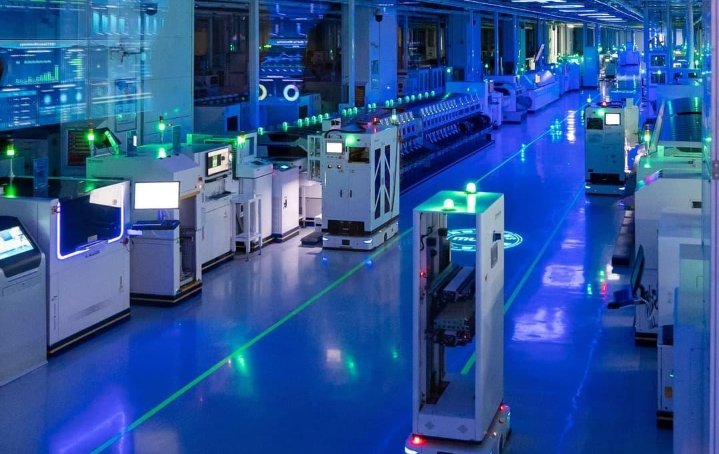
Over time, the Autonomous Industrial District could become an experimental environment for new manufacturing models. Autonomous mobile robots could operate across warehouses. Intelligent logistics systems could coordinate material movement. Digital permits could accelerate administrative processes. Smart utilities could optimize energy and water consumption. Industrial waste from one company could potentially become an input for another.
The important point is that Industry 4.0 would no longer be confined to the production line.
The factory would become part of a larger intelligent industrial network.
Such a system would not eliminate the need for human management. Instead, it could change where human attention is directed. Workers and managers would spend less time manually collecting information and coordinating routine processes and more time solving complex problems, improving production and making strategic decisions.
The concept also creates a different way of thinking about industrial infrastructure. Roads, electricity, warehouses and factories are traditionally treated as separate assets. An Industry 4.0 district treats them as components of an interconnected production ecosystem.
The long-term objective is therefore not simply to build smarter factories. It is to build industrial environments capable of sensing conditions, sharing appropriate information, predicting operational needs and coordinating resources.
An Autonomous Industrial District could represent the next stage of Industry 4.0: the transition from the intelligent factory to the intelligent industrial ecosystem. The factory remains the fundamental unit of production, but digital infrastructure allows neighbouring companies and shared systems to cooperate in ways that were previously difficult to achieve.
The industrial district of the future may therefore be defined not only by the factories it contains, but by the intelligence of the connections between them.