Industry 4.0 depends on enormous quantities of data. Machines, sensors, robots, cameras, vehicles and production systems continuously generate information about what is happening inside a factory. The traditional approach is to send much of this information to centralized cloud infrastructure for storage and analysis. This model is powerful, but industrial operations often require decisions to be made much closer to the machines themselves. Industrial Edge Computing Networks provide an infrastructure model in which computing power is distributed throughout industrial facilities, allowing data to be processed near the point where it is generated.
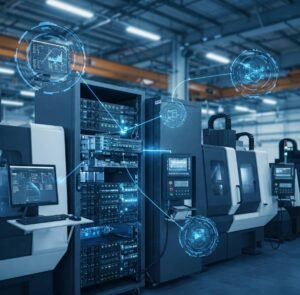
The basic idea is simple. Instead of sending every piece of machine data to a distant data centre, an industrial facility can deploy computing resources close to production equipment. These edge systems can receive information from machines, analyze it locally and provide immediate responses. Only the information that needs to be stored centrally or shared with other systems needs to travel further through the network.
This is particularly valuable in manufacturing because some industrial processes operate on extremely short timescales. A robotic production line may need to detect an abnormal condition and respond almost immediately. A machine-vision system inspecting products may generate enormous quantities of image data. An autonomous industrial vehicle may need to react to an obstacle within seconds or milliseconds.
Sending all this information to a remote cloud system can introduce latency and consume substantial network capacity.
Edge computing addresses this by moving computing closer to the physical operation.
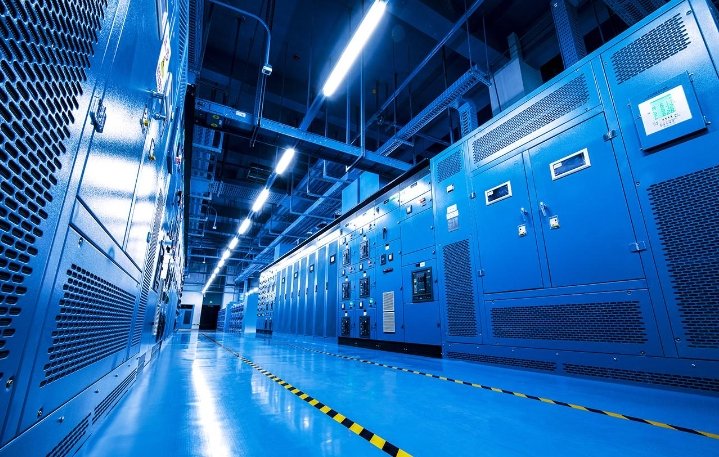
An Industrial Edge Computing Network could consist of ruggedized computing devices, industrial servers, specialized processors and networking equipment distributed throughout a factory or industrial park. These systems could operate close to production lines, warehouses, robots and other industrial assets.
The network would not replace cloud computing. Instead, it would create another layer between physical machines and centralized computing infrastructure.
The edge could handle immediate operational decisions. The cloud could handle long-term storage, large-scale analytics, model training, enterprise applications and coordination across multiple facilities.
This creates a distributed computing architecture.
Consider an automated quality-control system using cameras. A production line could generate thousands of images every minute. Sending every image to a remote data centre would consume considerable bandwidth. An edge computer positioned near the production line could analyze the images locally and identify defective products. Instead of transmitting every image, the system could send only relevant results, selected images or statistical information to a central platform.
This can reduce network traffic while increasing response speed.
Machine maintenance provides another application. Sensors attached to industrial equipment can continuously monitor vibration, temperature, pressure and other parameters. An edge system can analyze these signals in real time and identify abnormal conditions.
If a machine begins showing signs of deterioration, the local system could generate an alert immediately. It could also continue operating even if the external connection to a cloud platform is temporarily unavailable.
This resilience is important in industrial environments.
Factories cannot always assume that external networks will be available without interruption. A critical production process should not necessarily stop simply because an internet connection has failed. Edge computing allows essential functions to continue locally while the broader system reconnects.
Industrial cybersecurity can also benefit from this architecture. Sensitive operational data can be processed locally rather than automatically transmitted outside the facility. Security systems can monitor industrial traffic near its source and identify suspicious activity before it spreads through the network.
However, edge computing introduces its own security requirements. Edge devices are distributed across physical locations and may be more difficult to protect than centralized servers. They require secure configuration, authentication, software updates, physical protection and continuous monitoring.
The number of edge devices can become enormous as industrial connectivity expands.
An industrial facility may eventually have computing resources associated with individual production lines, warehouses, energy systems and autonomous vehicles. Managing these devices manually would become impractical. Centralized management platforms would therefore be required to monitor their health, deploy software updates and control access.
Artificial intelligence will be one of the major drivers of industrial edge computing.
AI models can analyze camera images, equipment signals and production data. Some applications require real-time inference. An edge computing system can run these models close to the machines, allowing rapid decisions without waiting for data to travel to a distant server.
For example, an AI vision system could identify a manufacturing defect while a product is still moving along the production line. The system could immediately signal a robotic mechanism to remove the defective item.
The same principle could apply to workplace safety. Cameras and sensors could identify restricted-area entry, unusual movement or potentially dangerous conditions. An edge system could issue immediate warnings while sending selected information to a central safety platform.
The industrial edge can also support autonomous vehicles. Automated guided vehicles and autonomous mobile robots require rapid processing of information from cameras, lidar, sensors and navigation systems. Local computing reduces the dependence on distant infrastructure and allows machines to respond quickly to changing conditions.
As factories become more autonomous, this capability becomes increasingly important.
Another opportunity is energy management. Edge computers can monitor electricity consumption, renewable generation, battery systems and equipment loads. They can identify changes in demand and coordinate appropriate responses locally.
An industrial facility with solar generation and battery storage could use edge computing to balance local energy flows in real time. A central cloud system could later analyze historical data and optimize broader strategies.
This combination of local and centralized intelligence is likely to become an important feature of future industrial infrastructure.
Industrial parks could take the concept further by creating shared edge computing networks. Instead of every factory building an entirely separate computing infrastructure, an industrial estate could provide common edge facilities distributed across the area.
These facilities could support logistics, cybersecurity, environmental monitoring, energy management and other shared services.
For small and medium-sized manufacturers, this could reduce the cost of adopting Industry 4.0 technologies. A factory could connect its machines to the industrial edge network and access computing capabilities without purchasing and managing an entire data centre.
The concept could also support industrial experimentation. Companies could deploy new AI models, digital-twin applications or machine-vision systems on shared edge infrastructure. This would make it easier to test new technologies before making larger investments.
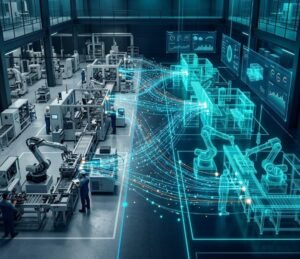
The relationship between edge computing and digital twins is particularly important. A digital twin requires continuous information from the physical environment. Edge systems can process sensor data locally and transmit the relevant information needed to keep the digital model updated.
The digital twin can then provide broader analysis while the edge continues to manage immediate operational requirements.
This creates a continuous loop between physical assets and digital intelligence.
The architecture also changes the role of industrial networks. Traditional networks primarily moved information from one location to another. An industrial edge network can become an active computing environment in which information is processed, interpreted and acted upon throughout the facility.
The network itself becomes part of the intelligence infrastructure.
There are challenges. Edge hardware must survive industrial environments involving heat, dust, vibration and electromagnetic interference. Computing resources must be reliable. Software must be compatible with industrial equipment. Cybersecurity must be maintained across thousands of distributed devices. Organizations also need employees capable of managing both operational technology and information technology.
These requirements make skills development essential.
Industrial workers and engineers increasingly need to understand networking, automation, cybersecurity, data systems and AI alongside traditional manufacturing knowledge. Training institutions will need to respond to this convergence.
The long-term potential of Industrial Edge Computing Networks lies in creating factories where intelligence is distributed rather than concentrated in a single location.
Cloud computing will continue to provide enormous centralized resources. But factories will increasingly require local intelligence capable of responding immediately to the physical world.
The Industry 4.0 factory may therefore operate through several interconnected layers: sensors collect information, edge systems interpret it, machines respond to immediate conditions, cloud platforms analyze broader patterns and AI systems continuously improve decision-making.
Industrial Edge Computing Networks provide the infrastructure connecting these layers.
The result is a manufacturing environment that can sense what is happening, process information close to the source and respond rapidly while remaining connected to larger digital systems. In this model, computing is no longer something that exists only inside a data centre. It becomes part of the industrial infrastructure itself.