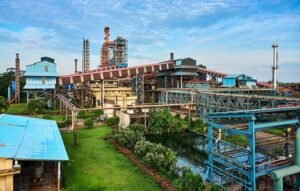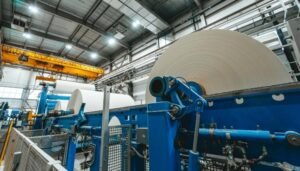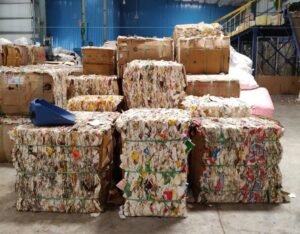
India’s titanium dioxide industry supplies one of the country’s most important industrial pigments. Titanium dioxide is widely used in paints, coatings, plastics, paper, cosmetics, pharmaceuticals, inks and construction materials because of its exceptional brightness, opacity and durability. As India’s manufacturing economy expands and exports of high-value materials increase, the titanium dioxide sector has an opportunity to adopt Industry 4.0 technologies that improve productivity, quality and sustainability.
Titanium dioxide production is a highly controlled chemical process involving mineral processing, chemical reactions, filtration, calcination, milling and packaging. Every production stage influences the final product’s particle size, whiteness, purity and performance. Maintaining consistency is essential because customers in industries such as paints and plastics demand uniform quality across every shipment.
Industry 4.0 introduces intelligent manufacturing systems where sensors continuously monitor production equipment and chemical processes. Information from reactors, kilns, filtration units, grinding systems and packaging lines is collected in real time, allowing engineers to observe plant performance without interruption.
Artificial intelligence strengthens process optimization by analysing production data collected over months and years. Machine learning algorithms identify relationships between operating conditions and product quality, enabling manufacturers to determine the most efficient production parameters. This improves yield while reducing raw material losses and production costs.
Calcination is one of the most energy-intensive stages of titanium dioxide manufacturing. Smart temperature monitoring and combustion control systems optimize kiln performance by continuously adjusting operating conditions. Reduced energy consumption lowers manufacturing costs while supporting environmental sustainability.
Digital twins provide manufacturers with virtual models of production facilities. Engineers can simulate equipment modifications, evaluate new operating conditions and test production strategies without affecting live operations. Virtual experimentation reduces technical risks while accelerating process improvements.
Predictive maintenance is particularly valuable because production equipment operates continuously under demanding industrial conditions. Crushers, mills, pumps, filters and rotary kilns require regular maintenance to maintain reliability. Connected monitoring systems detect abnormal vibration, temperature and mechanical wear before failures occur, allowing maintenance teams to schedule repairs efficiently.
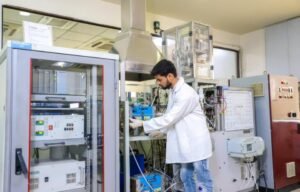
Online quality monitoring improves manufacturing precision. Automated analytical instruments continuously evaluate particle size distribution, chemical composition and colour characteristics throughout production. Immediate feedback enables operators to make process adjustments before product quality declines.
The paints and coatings industry, the largest consumer of titanium dioxide, increasingly requires consistent pigment performance for decorative and industrial applications. Industry 4.0 technologies help manufacturers deliver products with uniform optical properties, improving customer satisfaction and export competitiveness.
Raw material management also becomes more efficient. Titanium-bearing minerals vary in chemical composition depending on their source. Intelligent monitoring systems evaluate incoming raw materials and recommend process adjustments that compensate for natural variations, maintaining stable product quality.
Supply chain integration supports better business planning. Procurement, inventory management, production scheduling and customer demand forecasts can be connected through digital manufacturing platforms. Better coordination reduces storage costs while improving delivery performance.
Environmental monitoring has become increasingly important for pigment manufacturing. Smart systems continuously measure emissions, wastewater quality and energy consumption while automatically generating compliance reports. Manufacturers gain better visibility into environmental performance and can respond quickly to operational changes.
Water management is another important application. Titanium dioxide production requires substantial water for processing and purification. Digital monitoring systems optimize recycling, identify leakages and improve overall water efficiency, reducing both costs and environmental impact.
Worker safety benefits from connected industrial systems that monitor equipment performance, chemical handling and plant conditions. Automated warning systems notify operators immediately if abnormal operating conditions develop, allowing faster response to potential hazards.
Indian software companies and automation firms can develop specialized Industry 4.0 platforms for pigment manufacturing. Locally developed digital solutions can address India’s industrial requirements while reducing dependence on imported manufacturing technologies.
Engineering institutions should modernize chemical engineering education by introducing industrial automation, artificial intelligence, process analytics and digital manufacturing into academic curricula. Graduates equipped with these skills will support the continued modernization of India’s chemical sector.
Government initiatives promoting advanced manufacturing and industrial digitalization can accelerate Industry 4.0 adoption across the titanium dioxide industry. Financial incentives, research partnerships and workforce development programs can encourage wider implementation of smart manufacturing technologies.
Global demand for titanium dioxide continues to expand as construction, automotive manufacturing, infrastructure and consumer goods industries grow. India has an opportunity to strengthen its position in this market by combining established chemical engineering expertise with intelligent manufacturing systems.
Industry 4.0 enables manufacturers to move beyond traditional process control toward predictive, data-driven operations. Every connected sensor, digital twin and artificial intelligence model contributes to more efficient production, better product quality and stronger environmental performance.
By embracing smart manufacturing, India’s titanium dioxide industry can improve operational efficiency, strengthen export competitiveness and support the country’s broader ambition of becoming a leading global producer of advanced chemical materials.