Grain storage is one of the oldest industries in human history. From ancient granaries to modern silo complexes, the ability to safely store wheat, rice, maize, millet, and pulses has determined food security, economic stability, and national resilience. India possesses one of the world’s largest grain storage networks, serving farmers, food processors, government agencies, exporters, and consumers. As agricultural production continues to grow, Industry 4.0 can transform grain storage from a passive warehousing function into an intelligent, connected, and highly efficient operation.
Modern grain storage involves much more than simply keeping crops inside warehouses or silos. Operators must continuously manage temperature, humidity, pests, ventilation, grain quality, inventory movement, transportation, and distribution. Small failures in any of these areas can lead to spoilage, financial losses, and food waste.
Industry 4.0 begins with connected sensors installed throughout storage facilities. These sensors continuously monitor temperature, moisture, humidity, carbon dioxide levels, grain movement, ventilation systems, and structural conditions inside warehouses and silos. Instead of relying on periodic manual inspections, operators receive real time information every minute of the day.
Artificial intelligence converts this information into operational decisions. AI systems analyze environmental conditions, weather forecasts, storage duration, grain varieties, and inventory turnover to recommend ventilation schedules, storage arrangements, and maintenance activities. This reduces spoilage while extending the storage life of agricultural products.
Digital twins can further improve storage operations. Every warehouse or silo complex can have a virtual model that mirrors actual conditions in real time. Managers can simulate inventory movement, storage expansion, equipment upgrades, and emergency response plans before implementing operational changes.
Predictive maintenance is particularly valuable because grain facilities depend on conveyors, elevators, dryers, fans, motors, weighing systems, and automated handling equipment. Sensors continuously monitor vibration, electrical loads, temperatures, and mechanical performance. Artificial intelligence predicts equipment failures before breakdowns interrupt operations.
Machine vision systems improve quality assurance. Cameras inspect incoming grain for impurities, discoloration, damage, moisture variations, and foreign materials. Artificial intelligence classifies grain quality automatically, reducing inspection time while improving consistency.
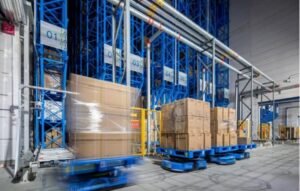
Robotics can automate repetitive warehouse activities including bag handling, pallet movement, inventory transfer, and loading operations. Automated guided vehicles transport grain within large storage facilities, improving productivity while reducing manual labor.
Supply chain integration extends Industry 4.0 beyond storage facilities. Farmers, procurement agencies, food processors, railways, ports, exporters, and retailers can exchange real time information regarding inventory availability, transportation schedules, and market demand. Better coordination reduces storage congestion while improving food distribution.
Energy efficiency is another major advantage. Grain storage facilities consume electricity for drying, ventilation, refrigeration, lighting, and material handling. Smart energy management systems optimize equipment usage according to weather conditions and inventory levels, reducing operating costs while lowering environmental impact.
Worker safety also improves through connected technologies. Environmental sensors detect dust accumulation, gas concentrations, fire risks, and unsafe operating conditions. Wearable devices and automated alerts improve emergency response while reducing workplace accidents.
Government food security programs also benefit from intelligent storage systems. Real time information on grain availability, regional inventories, storage conditions, and transportation capacity enables better planning for public distribution systems, emergency reserves, and disaster response.
The digital platform can integrate with agricultural markets, procurement systems, transport operators, ports, customs authorities, and export agencies. This creates a seamless information flow from farms to domestic consumers and international markets.
India stores millions of tonnes of grain every year, making storage efficiency a matter of national importance. Industry 4.0 technologies can significantly reduce food losses, improve inventory accuracy, strengthen food security, and increase operational efficiency across the country’s storage network.
Grain storage has supported civilizations for thousands of years. Today, it stands at the threshold of a new technological era. By integrating artificial intelligence, connected sensors, digital twins, robotics, machine vision, and predictive analytics, India’s grain storage industry can evolve into a smart infrastructure that supports agriculture, food security, and economic growth for decades to come.