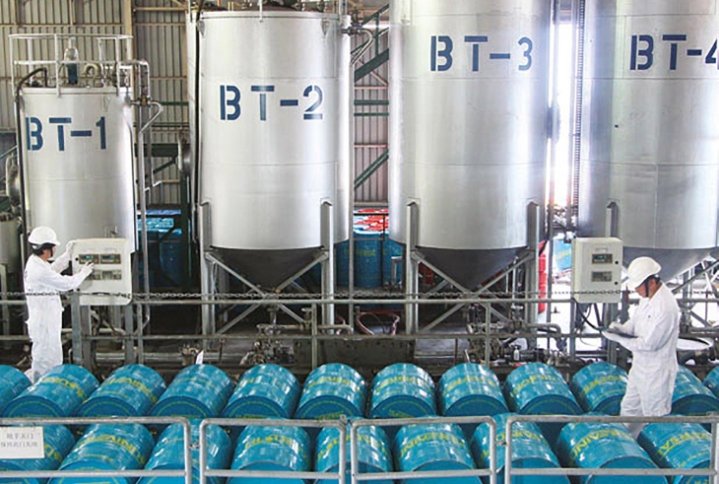
India’s industrial lubricants industry supports almost every manufacturing sector, including automotive, steel, mining, railways, aerospace, marine engineering, construction, power generation and heavy machinery. Industrial lubricants reduce friction, prevent corrosion, improve energy efficiency and extend equipment life. As manufacturing becomes increasingly automated and precision driven, Industry 4.0 provides an opportunity to modernize lubricant manufacturing through intelligent production systems that improve quality, productivity and sustainability.
Industrial lubricant manufacturing involves blending base oils with performance additives such as anti-wear agents, corrosion inhibitors, detergents, dispersants and viscosity modifiers. The formulation process demands precise control over ingredient proportions, temperature, mixing speed and filtration to ensure consistent product performance.
Industry 4.0 enables manufacturers to continuously monitor blending operations through connected sensors installed across storage tanks, mixing vessels, transfer pipelines, filtration systems and packaging lines. Real-time operational data provides engineers with complete visibility into manufacturing performance and product consistency.
Artificial intelligence strengthens production by analysing historical blending data together with live process information. Machine learning algorithms identify optimal mixing conditions that improve lubricant quality while reducing raw material losses, energy consumption and production time. Manufacturers can consistently produce high-performance lubricants while lowering operating costs.
Digital twins create virtual models of lubricant manufacturing plants. Engineers can simulate new formulations, evaluate equipment upgrades and optimize production schedules before implementing changes in actual facilities. This reduces technical risks while accelerating product development.
Predictive maintenance improves the reliability of pumps, mixers, compressors, filling machines and filtration systems. Connected monitoring devices analyse vibration, pressure, temperature and motor performance to detect equipment wear before breakdowns occur. Planned maintenance minimizes production interruptions and extends equipment life.
Quality assurance becomes more sophisticated through online analytical systems that continuously measure viscosity, density, additive concentration and contamination levels throughout production. Operators receive immediate feedback whenever quality parameters deviate from specifications, reducing rejected batches and improving customer satisfaction.
India’s automotive manufacturing sector represents one of the largest consumers of industrial lubricants. Smart manufacturing systems enable lubricant producers to supply engine oils, transmission fluids and specialty lubricants that meet increasingly demanding performance standards for modern vehicles, including electric and hybrid models.
Heavy industries such as steel, cement and mining require specialized lubricants capable of operating under extreme temperatures and heavy mechanical loads. Industry 4.0 helps manufacturers maintain consistent product characteristics for these demanding industrial applications.
Supply chain integration improves operational efficiency by connecting procurement, production planning, inventory management and customer orders into a unified digital platform. Manufacturers can respond more quickly to changing market demand while reducing inventory costs and improving delivery performance.
Energy optimization is another important application because blending plants rely on heating, pumping and packaging operations. Intelligent energy management systems continuously monitor utility consumption, identify inefficiencies and recommend adjustments that lower operating costs without affecting production quality.
Environmental sustainability is becoming increasingly important as manufacturers develop biodegradable lubricants and lower-emission production processes. Industry 4.0 enables continuous monitoring of emissions, waste generation, solvent recovery and energy use, helping companies achieve environmental objectives while maintaining productivity.
Water management systems equipped with connected sensors optimize cooling operations, detect leaks and improve recycling throughout manufacturing facilities. Reduced water consumption supports both sustainability and operational efficiency.
Worker safety improves through intelligent monitoring of storage tanks, pumping systems and chemical handling operations. Automated warning systems immediately notify operators whenever abnormal conditions develop, reducing industrial risks associated with flammable materials and high-pressure equipment.
Research and development benefits significantly from Industry 4.0 technologies. Artificial intelligence analyses formulation data, customer feedback and field performance to identify opportunities for developing next-generation lubricants with improved durability, efficiency and environmental performance.
Indian software companies can develop specialized manufacturing execution systems, formulation management platforms and predictive analytics software specifically designed for lubricant manufacturing. Such domestic innovations strengthen India’s industrial automation capabilities while reducing dependence on imported software.
Engineering institutions should expand chemical engineering and mechanical engineering curricula to include industrial automation, artificial intelligence, digital manufacturing and smart process control. Future professionals will increasingly manage intelligent lubricant production systems supported by advanced analytics.
Government initiatives promoting advanced manufacturing, industrial digitalization and sustainable chemicals can accelerate Industry 4.0 adoption across the lubricant industry. Collaboration among manufacturers, research institutions and technology firms can support innovation while improving global competitiveness.
Global demand for high-performance industrial lubricants continues to grow alongside advanced manufacturing, renewable energy, aerospace and electric mobility. India possesses strong refining capabilities, a large domestic market and expanding manufacturing infrastructure that position it well for future growth.
Industry 4.0 transforms lubricant manufacturing into a connected, intelligent production ecosystem where quality, efficiency and sustainability are continuously optimized. By integrating artificial intelligence, predictive maintenance, digital twins and real-time quality monitoring, India’s industrial lubricants industry can strengthen its role in supporting modern manufacturing while becoming a globally competitive supplier of advanced lubrication technologies.