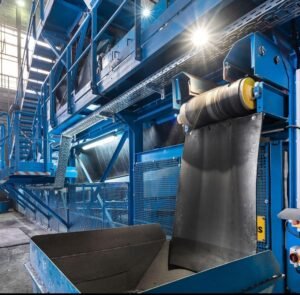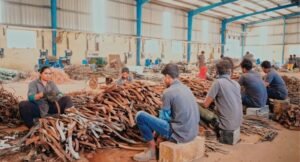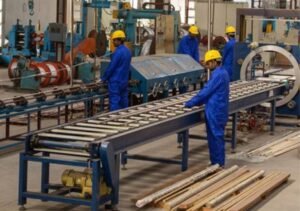
The next frontier of Industry 4.0 may lie not in producing more goods, but in transforming industrial waste into valuable resources through intelligent, interconnected manufacturing systems. Factories generate rejected components, metal scrap, chemical residues, excess heat, wastewater, packaging materials, and unused by-products. Much of this material has economic value, yet identifying, sorting, transporting, and processing it efficiently remains a challenge.
A radical industrial strategy would treat every waste stream as a potential product stream and use artificial intelligence to discover where that value can be recovered.
Imagine a factory in which every discarded component is digitally recorded. Sensors identify its material composition, machine-vision systems detect defects, and software estimates whether it can be repaired, remanufactured, recycled, or redirected to another industry. Instead of sending all rejected products to a common disposal facility, the factory creates a detailed inventory of recoverable resources.
This approach could transform industrial waste management from a compliance activity into a core business function.
The concept becomes more powerful when multiple factories are connected through a shared industrial resource network. A steel manufacturer’s suitable by-products might serve another company’s production requirements. Waste heat from one facility could potentially support a nearby industrial process. Recovered plastics, metal components, and process water could be routed to users capable of extracting further value.
Such exchanges already exist in some industrial clusters, but digital coordination could make them easier to discover and manage. A shared platform could match available materials with demand, compare transport costs, check technical specifications, and estimate the financial benefits of recovery.
Artificial intelligence could also identify patterns that individual factories might overlook. If several production lines repeatedly generate similar defective components, analytics could identify the underlying manufacturing problem. If a particular by-product consistently accumulates in storage, the system could search for alternative applications or recommend changes in production planning.
Digital twins could help evaluate these possibilities before expensive modifications are introduced. Engineers could simulate alternative recycling processes, estimate material recovery rates, and compare the energy requirements of different solutions.
For India, this approach could be especially relevant to industrial estates containing small and medium-sized enterprises. Many smaller manufacturers cannot independently afford sophisticated waste-processing equipment or maintain specialized materials laboratories. Shared facilities equipped with sorting systems, testing instruments, and recycling technologies could distribute these costs across multiple businesses.
Industrial resource exchanges could also create opportunities for startups. Entrepreneurs could specialize in recovering specific materials, developing affordable sensors, manufacturing products from industrial residues, or building software that coordinates resource transactions. This would create economic activity around materials that businesses currently regard primarily as disposal liabilities.
Government policy could accelerate adoption by supporting pilot projects, establishing material-quality standards, and encouraging industrial estates to publish verified information about recoverable by-products. Financial incentives could be linked to measurable outcomes, including reduced waste generation, lower resource consumption, and verified recovery of materials.
However, digital matching alone cannot make every waste stream reusable. Contamination, inconsistent material quality, hazardous substances, transportation costs, and regulatory restrictions can make recovery uneconomical or unsafe. Independent testing and traceability would therefore be essential. Companies must also protect commercially sensitive production information when sharing data through common platforms.
The broader opportunity is to combine Industry 4.0 with the principles of a circular economy. Traditional manufacturing systems often treat resources as inputs and waste as an unavoidable output. Intelligent industrial networks can instead connect production, recovery, remanufacturing, and reuse into a coordinated economic system.
The objective is not to eliminate waste through software alone. It is to redesign industrial operations so that fewer resources are discarded unnecessarily and more value is recovered from the materials already in circulation.
India could build a competitive advantage by developing the technologies, industrial platforms, and business models required for this transformation. The factory of the future should not merely manufacture products efficiently. It should also understand the value of its residual materials and participate in a wider network that converts industrial losses into economic opportunities.