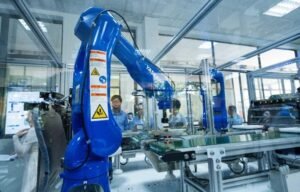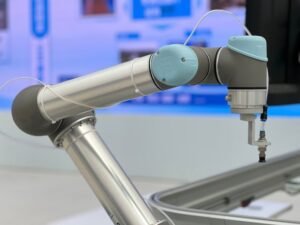
Industry 4.0 discussions often focus on robots performing sophisticated manufacturing tasks. Automated production lines, robotic arms, computer vision and artificial intelligence create the impression that the factory of the future will operate with very little human involvement.
India’s reality is likely to be considerably more complicated.
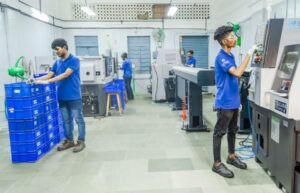
A factory can have highly automated machines and still depend heavily on people for the activities surrounding those machines.
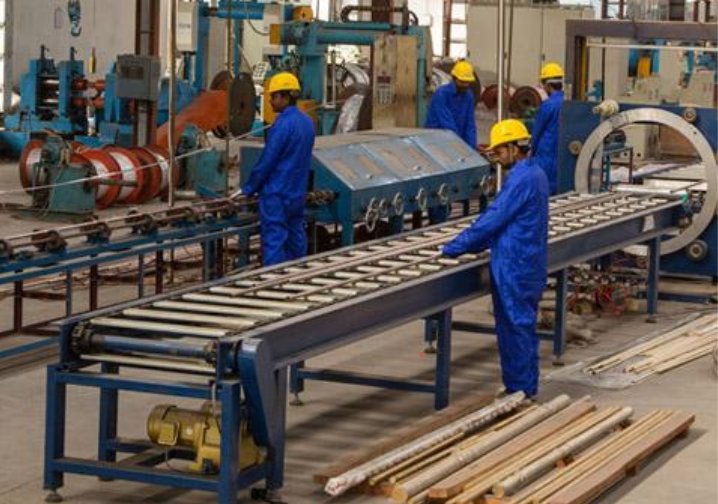
Materials have to arrive at the correct workstation. Components have to be moved between production stages. Finished products have to be inspected, labelled, packed and dispatched. Tools have to be changed. Rejected products have to be removed. Machines have to be cleaned. Production information has to be verified.
These activities form the last mile of factory automation.
They are often overlooked because they do not appear as technologically impressive as the main production process.
A robotic arm may manufacture a component automatically, but someone may still have to bring the raw material to the machine.
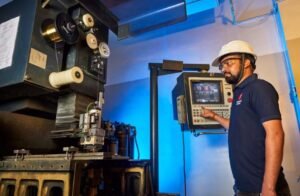
A CNC machine may operate continuously, but an employee may still need to load and unload components.
An automated inspection system may identify defective products, but someone may still need to separate, document and process them.
This creates a strange situation.
The core production process becomes automated while the surrounding activities remain manual.
For Indian manufacturers, this gap can become a major barrier to Industry 4.0 productivity.
Automation works best when the entire production system is considered as one connected process. If one part becomes extremely fast while another remains slow, the bottleneck simply moves.
Imagine a factory installing a high-speed automated production machine.
The machine can produce twice as many components as the previous equipment. But if materials are delivered manually and finished products are moved using traditional methods, the production machine may frequently wait.
The company has purchased automation.
But it has not necessarily purchased additional output.
This is why material movement deserves much more attention in India’s Industry 4.0 conversation.
Factories contain enormous amounts of movement that do not directly add value to the product.
Raw materials move from storage to production. Components move between machines. Semi-finished products wait between processes. Finished goods move to inspection and packaging. Packaging materials move in the opposite direction.
Every movement consumes time, labour and energy.
Some factories may eventually use automated guided vehicles, autonomous mobile robots, smart conveyors and digitally managed warehouses to reduce these inefficiencies.
But the bigger opportunity may come from understanding the movement before automating it.
A factory should first know where materials are, where they need to go, how long they spend waiting and why delays occur.
Without this information, automation can simply reproduce an inefficient process at higher cost.
This is another example of why Industry 4.0 is not simply an equipment problem.
It is a process-design problem.
India’s labour environment makes the issue even more interesting.
Automation is often discussed as a replacement for human labour. But in many factories, the more realistic outcome may be a redistribution of human work.
Employees who currently spend hours moving materials could potentially move into quality control, machine supervision, maintenance support, inventory management or other higher-value activities.
The question is therefore not simply how many jobs automation eliminates.
It is what kinds of work emerge around automated systems.
This could be especially important for India’s manufacturing ambitions because the country needs both productivity growth and large-scale employment.
A successful Industry 4.0 model cannot necessarily be based on removing humans from every process.
It may instead involve removing unnecessary physical effort while increasing the value of human work.
For example, an employee who spends most of a shift transporting components between machines could potentially become responsible for monitoring several automated material-handling systems.
The physical movement becomes automated.
The human role becomes supervisory.
This requires new skills.
Workers need to understand basic digital interfaces, inventory systems, machine alerts and operational exceptions. Maintenance personnel need to understand both mechanical equipment and digital control systems.
The factory therefore becomes more automated without necessarily becoming completely human-free.
There is another hidden challenge.
Indian factories often operate in environments where layouts have evolved gradually.
A production area may have been designed for one generation of equipment and modified repeatedly as new machines were added. Storage areas may have moved. Production lines may have been expanded. Temporary material storage may have become permanent.
Automating material movement in such an environment can be difficult.
An autonomous vehicle works best when routes, storage locations and operating rules are clearly defined.
A constantly changing factory floor creates uncertainty.
This means that physical factory design may need to change alongside digital transformation.
The smart factory of the future may require clearly defined movement corridors, digital identification of materials, standardised storage locations and real-time inventory information.
Technologies such as RFID, machine vision and location systems could eventually allow factories to know where individual materials or batches are located.
That information could then be connected to production planning.
Instead of an employee searching for a component, the system could know where the component is and direct its movement to the correct workstation.
This may sound like a small improvement.
Across thousands of movements every day, however, small improvements can become significant productivity gains.
India’s Industry 4.0 opportunity therefore extends beyond the machine.
It includes everything that happens between machines.
The factory may eventually become a network in which production equipment, warehouses, workers, materials and transportation systems continuously exchange information.
The real breakthrough will occur when these systems stop functioning as separate islands.
A production machine can tell the system that it needs material.
The inventory system can confirm availability.
The warehouse system can identify the material’s location.
An automated vehicle can transport it.
The production system can confirm arrival.
The entire transaction can happen without multiple phone calls, paper records or manual coordination.
This is the deeper meaning of the last-mile automation problem.
The hardest part of Industry 4.0 may not be automating the most sophisticated machine.
It may be connecting all the ordinary activities around that machine.
India has millions of workers, machines, warehouses and production facilities that could gradually become part of such systems.
The opportunity is enormous.
But the objective should not be automation for its own sake.
The objective should be eliminating unnecessary waiting, searching, walking, carrying, duplication and uncertainty.
A truly smart factory is not one where humans disappear.
It is one where humans no longer spend their valuable time solving problems that machines and information systems can solve better.
The future of Indian manufacturing may therefore depend not only on how intelligently a machine produces something, but on how intelligently everything around that machine moves.