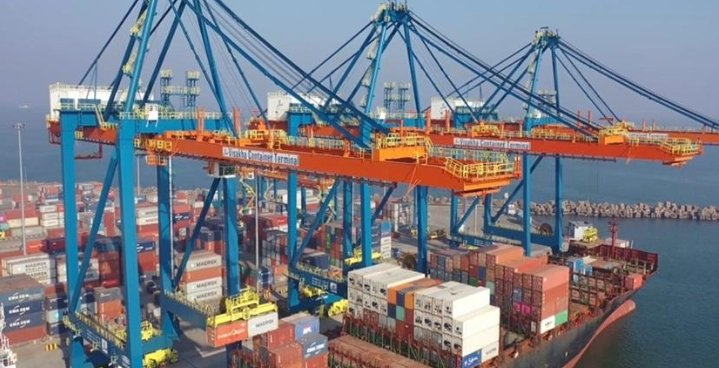
India has built major ports, highways, industrial corridors and logistics networks, but much of the country’s trade infrastructure is designed around moving whatever cargo happens to arrive. A more unconventional strategy would be to build entire trade corridors around specific commodities.
Instead of asking how India can increase exports in general, policymakers could ask a narrower question: which commodity can justify an entire international trade ecosystem?
A commodity-focused corridor would connect producers, processors, warehouses, testing laboratories, logistics companies, ports, banks, insurers and foreign buyers around one particular product category.
Consider agricultural commodities. India could develop specialised corridors for spices, seafood, rice, processed foods or tropical fruits. The corridor would not simply move the product from farm to port. It would create an integrated export system around it.
Warehouses could provide commodity-specific storage. Laboratories could conduct quality and residue testing. Packaging companies could operate nearby. Banks could develop specialised working-capital products. Logistics companies could offer scheduled export services. Foreign buyers could receive predictable supply throughout the year.
The same model could work for industrial products.
India could create a machinery corridor connecting component manufacturers, machining companies, heat-treatment facilities, testing laboratories, refurbishment companies and exporters. A foreign buyer searching for industrial equipment would then encounter an ecosystem rather than hundreds of disconnected suppliers.
This distinction is important.
International buyers often struggle not because India lacks manufacturers, but because the supply chain is fragmented. One company makes the shaft, another makes the gear, another performs heat treatment, another handles machining and another supplies the motor.
A specialised corridor could connect these capabilities.
The corridor could ultimately function almost like a virtual factory.
A foreign buyer could place an order for a complete industrial system, while different Indian companies manufacture individual components. A coordinating company could integrate the supply chain, conduct testing and ship the final system.
This could give Indian MSMEs access to international contracts that would otherwise be too large for individual companies.
Commodity corridors could also be designed around foreign markets.
India could create dedicated export corridors for East Africa, the Gulf, Central Asia or Southeast Asia. Within each corridor, specific Indian manufacturing clusters could be connected to distributors and warehouses in the destination region.
The objective would be to reduce the number of independent transactions required to complete international trade.
One Indian manufacturer should not have to independently discover a buyer, negotiate shipping, arrange inspection, find warehousing, manage foreign documentation and establish after-sales support.
The corridor could provide these services collectively.
This model becomes particularly interesting when combined with ports.
An Indian port could specialise in becoming the preferred gateway for a particular class of goods. Around that port, companies could establish consolidation warehouses, inspection facilities, packaging units and export finance services.
The result would be an industrial ecosystem designed around trade rather than merely around manufacturing.
Such corridors could also create stronger bargaining power.
If hundreds of small producers collectively supply an international market, they can achieve shipping volumes, procurement efficiencies and marketing capabilities that individual firms cannot achieve.
The government would not necessarily need to own these corridors.
Its role could be to provide infrastructure, common standards, digital systems and incentives while private companies operate the actual businesses.
India could even invite foreign buyers to become anchor participants.
A large African distributor, Gulf retailer or Southeast Asian industrial group could commit to buying from a particular corridor for several years. Indian producers would then have greater confidence to invest in capacity.
This changes export policy from a seller-driven model to a demand-driven model.
Instead of producing first and searching for buyers later, India could identify a large foreign demand pool and build the supply ecosystem around it.
The idea could be extended beyond physical goods.
A corridor for renewable-energy equipment, for example, could combine manufacturing, engineering design, installation, maintenance, financing and training. The export would then be an entire industrial capability rather than a collection of products.
The most important advantage may be predictability.
International trade becomes much easier when buyers know where to go, whom to contact, what standards apply, how quickly goods can be delivered and what support exists after the sale.
India has enormous manufacturing depth. Its challenge is often not capability but coordination.
Commodity-focused trade corridors could provide that coordination.
Instead of trying to make every Indian industrial cluster globally competitive in everything, India could deliberately build a few exceptionally deep ecosystems around carefully selected commodities and markets.
The result would be something more powerful than an export zone.