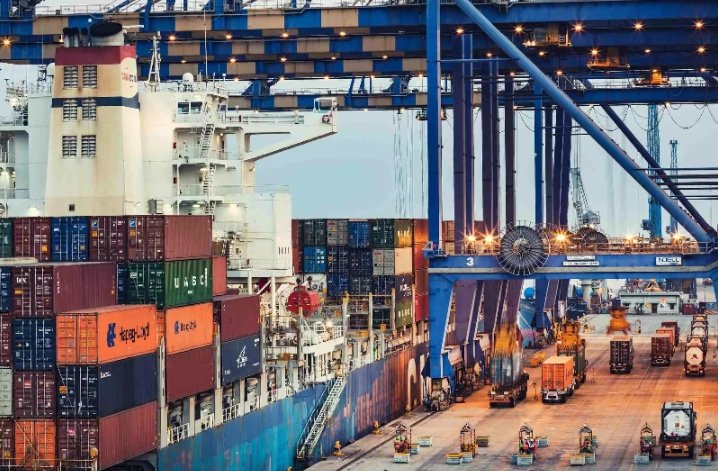
India’s ports are designed primarily around moving cargo. Containers arrive, containers leave, and the efficiency of the system is usually measured through the volume of goods handled.
But a port can do much more than move goods.
India could develop specialised industrial trade hubs around its major ports, designed specifically for engineering components, machinery, spare parts and intermediate goods.
The idea is simple. Bring together manufacturers, warehouses, inspection companies, customs services, logistics providers and international buyers in one ecosystem.
A foreign buyer looking for an unusual industrial component should not have to search through hundreds of disconnected suppliers.
They should be able to enter an Indian industrial trade hub, identify suppliers, inspect products, obtain certification, consolidate multiple orders and ship everything through the nearby port.
This would be particularly valuable for small and medium-sized Indian manufacturers.
A company producing precision gears may be excellent at manufacturing but have little experience with international logistics. Another company may produce bearings. Another may specialise in castings. Individually, these companies may be too small to build global distribution networks.
A specialised trade hub could aggregate them.
The hub becomes the international face of an entire manufacturing ecosystem.
This model could also change how India approaches exports to developing markets.
Instead of selling individual products through traditional distributors, Indian industrial hubs could supply entire categories of components to regional markets in Africa, West Asia and Southeast Asia.
A warehouse near a port could hold thousands of different components. International customers could order small quantities from multiple Indian manufacturers and receive one consolidated shipment.
That solves one of the biggest problems facing small exporters.
Minimum order quantities.
A factory overseas may need only a few replacement gears, some bearings and a small batch of mechanical seals. Traditional exporters may not find such an order attractive.
An aggregated trade hub can.
The economic value comes from coordination.
India already has manufacturing capacity spread across industrial clusters. What is missing is often the infrastructure that connects those clusters efficiently to international buyers.
Ports could become that connection.
Trade hubs could also include testing and certification facilities. A buyer should be able to verify material quality, dimensions, tolerances and performance before accepting an order.
Trust is one of the biggest barriers in international trade.
A recognised Indian industrial trade hub could reduce that uncertainty.
Digital infrastructure would make the model even more powerful. Every component could have a searchable technical profile containing specifications, manufacturing capabilities, certifications, production capacity and delivery information.
The physical hub and digital marketplace would work together.
A buyer could discover a component online, request samples, arrange inspection, consolidate the order and ship it through the same ecosystem.
This would create a new kind of export infrastructure.
Not simply a port.
Not simply an industrial park.
A global marketplace physically connected to India’s manufacturing base.
The model could also support India’s ambition to become a major manufacturing power without requiring every manufacturer to become a large corporation.
Small specialised manufacturers could remain specialised.
The trade ecosystem would provide the scale.
India has spent decades developing industrial clusters. The next challenge is to connect those clusters to global demand more intelligently.
The future of Indian trade may depend not only on how much the country manufactures.
It may depend on how easily the world can find what India already manufactures.
A port that merely moves containers is logistics infrastructure.
A port surrounded by an ecosystem that discovers, certifies, finances, consolidates and exports Indian industrial capabilities becomes something much more powerful.
It becomes trade infrastructure for the next generation of Indian manufacturing.