India is one of the world’s largest producers of textiles and garments. The industry supports millions of jobs while supplying fabrics, apparel, technical textiles, home furnishings, and industrial materials to both domestic and international markets. Among the various stages of textile manufacturing, dyeing is one of the most resource-intensive processes, consuming large quantities of water, chemicals, steam, and electricity. Industry 4.0 technologies provide an opportunity to modernize textile dyeing through intelligent automation, artificial intelligence, digital twins, and real-time process control.
Traditional dyeing operations often depend on manual supervision and operator experience. Small variations in temperature, chemical concentration, water quality, or processing time can affect colour consistency and product quality. These variations may also increase waste, reprocessing, and production costs. Smart textile dyeing plants replace manual decision making with continuous digital monitoring and automated process optimization.
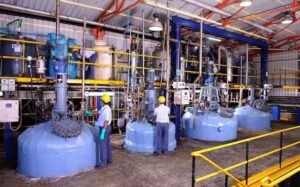
The transformation begins with industrial sensors installed throughout the production facility. Dyeing machines, chemical tanks, boilers, pumps, heat exchangers, pipelines, and wastewater systems continuously generate operational information. Temperature, pressure, pH, flow rate, dye concentration, steam usage, water consumption, and machine performance are monitored in real time.
Artificial intelligence analyses these data streams every second. Instead of waiting until defects appear, AI predicts deviations before they occur and automatically adjusts process parameters. Dye concentration, heating cycles, mixing speed, and processing duration can all be optimized dynamically, ensuring that every production batch maintains consistent colour quality.
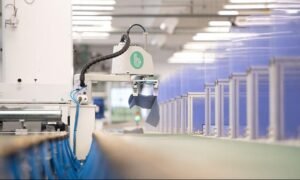
Machine vision technology further strengthens quality assurance. High-resolution cameras inspect fabrics immediately after dyeing. Artificial intelligence compares the finished colour against digital standards, detecting even minor differences that may not be visible during manual inspection. Products that do not meet specifications are identified immediately, reducing customer complaints and production waste.
Digital twin technology creates a virtual replica of the dyeing plant. Engineers can simulate new fabric types, dye formulations, production schedules, and equipment modifications without interrupting ongoing operations. Process improvements are validated digitally before being introduced into the physical factory, reducing operational risks and accelerating innovation.
Water conservation is one of the greatest benefits of Industry 4.0 in textile manufacturing. AI continuously measures water usage throughout every stage of production and recommends methods for reducing unnecessary consumption. Water recycling systems can be integrated into the digital platform, allowing treated wastewater to be reused wherever possible without affecting product quality.
Chemical management also becomes more efficient. Intelligent dosing systems automatically measure and dispense dyes, salts, alkalis, acids, and finishing chemicals with exceptional precision. This reduces chemical waste while improving consistency across production batches.
Predictive maintenance helps maximize factory productivity. Pumps, motors, valves, compressors, dyeing machines, and heat exchangers continuously report their operating condition. Artificial intelligence analyses vibration, energy consumption, temperature, and mechanical behaviour to predict equipment failures before production is interrupted.
Energy efficiency represents another important advantage. Textile dyeing requires substantial quantities of steam, electricity, and hot water. AI optimizes boiler performance, heat recovery systems, and production scheduling to reduce energy consumption while maintaining production targets. Lower energy use improves profitability and reduces environmental impact.
Environmental compliance becomes easier through continuous digital monitoring. Wastewater quality, chemical discharge, emissions, and treatment plant performance are measured automatically. Digital records simplify regulatory reporting while helping manufacturers maintain international environmental standards required by export markets.
Supply chain integration improves responsiveness throughout the textile industry. Production planning systems communicate directly with yarn suppliers, fabric manufacturers, garment producers, warehouses, and customers. Orders, inventory levels, production schedules, and shipping activities become synchronized through shared digital information.
Worker safety also improves significantly. AI continuously monitors hazardous chemical storage, steam systems, electrical equipment, confined spaces, and factory air quality. Early warnings allow supervisors to address potential safety risks before accidents occur.
Research and development teams benefit from the enormous volume of production data generated every day. Engineers can analyse process performance to develop new dyeing techniques, improve colour fastness, reduce chemical usage, and create more sustainable textile manufacturing methods.
India already possesses strong expertise in textiles, engineering, industrial automation, software development, and artificial intelligence. Integrating these strengths through Industry 4.0 can modernize one of the country’s most important manufacturing sectors. Smart Textile Dyeing Plants would reduce water consumption, improve product quality, increase operational efficiency, strengthen export competitiveness, and help establish India as a global leader in sustainable textile manufacturing.