
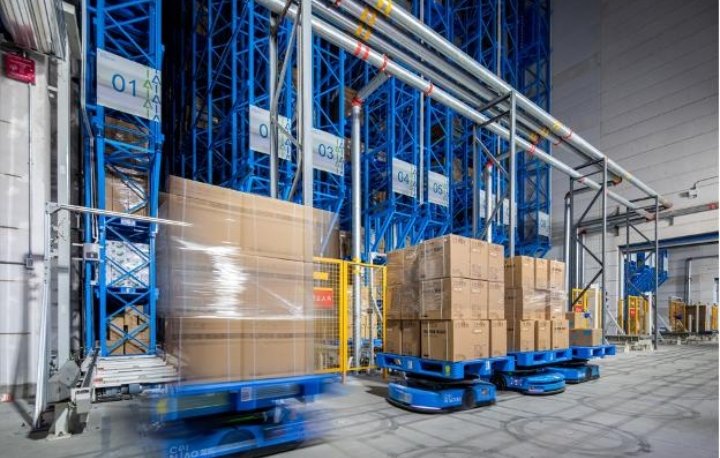
Warehousing has traditionally been viewed as a supporting function within manufacturing and trade. Products are stored, inventoried and dispatched according to demand. However, Industry 4.0 is transforming warehouses into intelligent production assets where robotics, artificial intelligence, machine vision and autonomous vehicles work together to improve efficiency. India has an opportunity to take this transformation further by creating autonomous warehouses that function as shared infrastructure for thousands of manufacturers instead of being owned individually by large corporations.
Today, advanced automated warehouses remain concentrated among a handful of multinational companies and major e-commerce platforms. The high cost of robotics, automated storage systems, conveyor networks and warehouse software prevents most small and medium enterprises from adopting these technologies. As a result, productivity differences between large and small manufacturers continue to widen.
India could address this challenge through a policy that encourages the development of Autonomous Warehouse Parks. These facilities would operate as common industrial utilities where businesses rent storage, robotic handling, packaging and dispatch services according to their needs. Instead of investing hundreds of crores in private automation, manufacturers would pay only for the warehouse capacity they actually use.
Such a model would resemble the evolution of cloud computing. Companies no longer build their own data centres for every application. Instead, they purchase computing resources from shared cloud providers. Warehousing can evolve in a similar direction, where automation becomes a service rather than an expensive capital investment.
Each warehouse could combine automated guided vehicles, robotic picking systems, automated storage and retrieval systems, machine vision inspection, intelligent inventory management and AI-driven scheduling. Goods entering the warehouse would be automatically identified, sorted, stored and prepared for shipment with minimal human intervention.
Policy support could encourage these facilities near manufacturing clusters, ports, airports and freight corridors. Strategic locations would reduce transportation costs while improving export competitiveness. Manufacturers in automotive, electronics, pharmaceuticals, textiles, engineering goods and consumer products could all benefit from shared automated logistics infrastructure.
Digital integration would make these warehouses even more valuable. Production planning systems inside factories could communicate directly with warehouse management software. Inventory would move automatically according to production schedules, customer orders and transportation availability. Manufacturers would gain real-time visibility over inventory levels without maintaining large storage facilities inside their own factories.
Artificial intelligence could continuously optimise warehouse operations. Algorithms would determine the most efficient storage locations, predict future demand, minimise travel distances for robotic systems and schedule dispatches based on shipping priorities. Over time, the warehouse would become more efficient as it learns seasonal demand patterns and customer behaviour.
Energy management should become an integral part of warehouse design. Rooftop solar installations, battery storage systems, intelligent lighting, automated climate control and regenerative braking technologies could significantly reduce operating costs. Warehouses operating twenty-four hours a day would become important examples of energy-efficient industrial infrastructure.
Autonomous warehouses could also provide value-added manufacturing services. Products arriving from multiple suppliers could be assembled into export kits, customised for different markets, labelled in multiple languages, inspected for quality and packaged according to destination country regulations. This would allow smaller manufacturers to access sophisticated export services without developing these capabilities independently.
The government could establish standards for interoperability between warehouse software, robotics suppliers and manufacturing systems. Open technical standards would prevent dependence on proprietary platforms while encouraging innovation by Indian software companies and equipment manufacturers.
Financing models will determine how quickly this ecosystem develops. Infrastructure investment funds, industrial development banks and public-private partnerships could support construction of autonomous warehouse parks. Tax incentives for robotics deployment and accelerated depreciation on automation equipment would encourage private participation.
India’s startup ecosystem can play an important role. Rather than competing only in software applications, startups could develop warehouse robotics, machine vision systems, inventory optimisation algorithms, autonomous forklifts, inspection drones and predictive maintenance platforms. Shared warehouse infrastructure would provide a large domestic market for these technologies before they expand internationally.
Skill development should accompany physical infrastructure. Technical institutes could introduce specialised programmes covering warehouse automation, industrial robotics, logistics analytics, autonomous systems maintenance and AI-driven supply chain management. These skills will become increasingly valuable as automation spreads throughout manufacturing.
Export competitiveness depends not only on factory productivity but also on logistics efficiency. International buyers expect reliable inventory management, rapid order fulfilment and transparent shipment tracking. Autonomous warehouses can reduce shipping delays, minimise inventory errors and improve delivery performance, strengthening India’s reputation as a dependable manufacturing partner.
Rural industrial development could also benefit. Smaller manufacturing clusters often struggle to justify investment in sophisticated logistics infrastructure. Shared autonomous warehouses located near regional industrial parks would allow businesses outside major metropolitan areas to access world-class logistics capabilities, supporting more balanced economic development.
As global manufacturing becomes increasingly data-driven, warehouses will evolve into intelligence centres rather than simple storage facilities. Every movement of goods generates information about demand, production efficiency, transportation performance and customer behaviour. Properly analysed, this data can improve industrial planning across entire sectors.
Countries competing for manufacturing investment increasingly offer integrated industrial ecosystems rather than isolated factories. Investors evaluate logistics infrastructure, digital connectivity, workforce quality and operational efficiency alongside production costs. Autonomous warehouse networks would strengthen India’s industrial ecosystem by reducing barriers for manufacturers of every size.
Instead of viewing warehouse automation as a technology reserved for large corporations, India can position it as shared national infrastructure that supports industrial growth across the economy. By treating autonomous warehouses as common utilities similar to highways, ports and industrial parks, policymakers can make advanced logistics accessible to thousands of businesses, improve export competitiveness and accelerate the country’s transition towards a more productive and resilient Industry 4.0 economy.