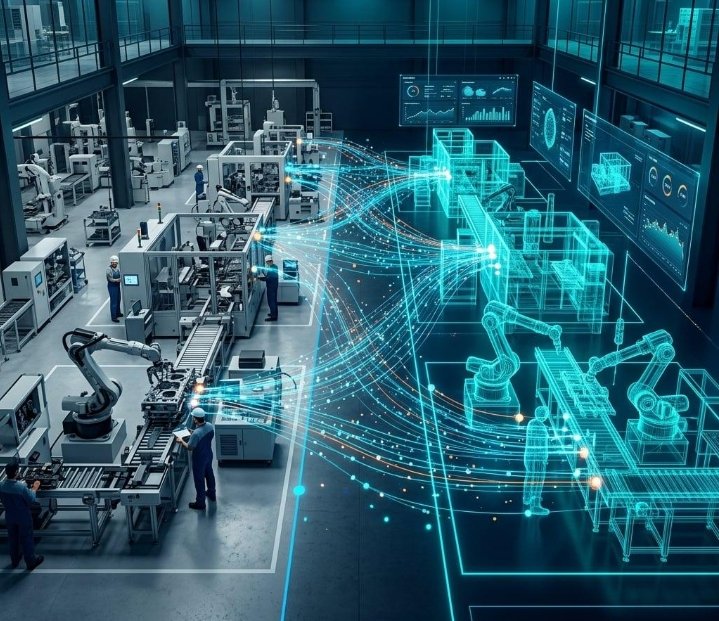
The next stage of Industry 4.0 may not be another machine, robot or software application. It may be a digital representation of the entire industrial operation. An Industrial Digital Twin can create a continuously updated virtual model of a factory, production line, warehouse, energy system and supporting infrastructure, allowing companies to understand what is happening in the physical world and test possible changes before implementing them.
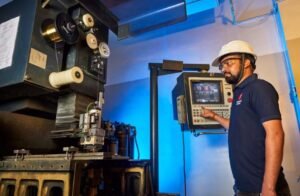
A traditional factory relies heavily on physical observation. Engineers inspect machines, managers examine production reports, maintenance teams respond to failures and supervisors monitor workers and equipment. Digital systems have already transformed many of these activities, but information can still remain fragmented across different machines and software platforms.
A digital twin attempts to connect these systems into a coherent representation of the physical operation.
Sensors installed throughout a factory can continuously collect information about equipment temperature, vibration, pressure, energy consumption, production speed and other relevant parameters. Production management systems can provide information about orders and manufacturing schedules. Warehouse systems can track inventories. Maintenance platforms can record equipment history. The digital twin brings selected information together so that the current state of the physical facility can be represented digitally.
The value of the system comes from what can be done with this representation.
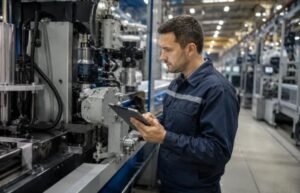
An engineer could examine the digital model and identify a machine whose performance is gradually changing. Instead of waiting for a breakdown, the maintenance team could investigate the equipment while production is still operating. A production manager could simulate a change in the production sequence and examine its possible effect on bottlenecks. An energy manager could model different operating schedules to understand their effect on consumption.
This makes the digital twin more than a visualization tool. It becomes an environment for decision-making.
One of the most powerful applications is simulation. Manufacturing systems are complex. Changing one part of a production line can affect many other parts. A new machine may increase production capacity but create a bottleneck further down the line. Increasing production may require additional warehouse capacity. A faster production schedule may increase electricity demand.
Testing such changes physically can be expensive and disruptive. A digital twin provides a virtual environment in which possible scenarios can be examined before resources are committed.
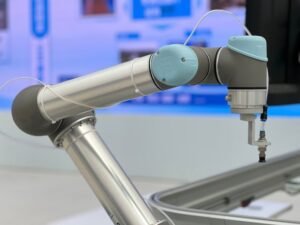
For example, a manufacturer planning to add a robotic assembly station could construct a digital representation of the proposed equipment. The model could incorporate expected production rates, material flows, worker movements and existing machine capacities. Managers could then examine several configurations before deciding where the robot should be installed.
The same principle applies to factory expansion.
Instead of designing a new facility entirely through static drawings, companies could develop a digital model containing production equipment, material movement, energy systems and logistics requirements. Different layouts could be evaluated before construction begins.
This could reduce costly design mistakes.
Digital twins can also improve commissioning. When a new production line is installed, the digital model can be used alongside the physical system to compare expected performance with actual performance. Deviations can be identified early. Engineers can investigate whether the problem originates from equipment settings, material flow, software configuration or another source.
The technology becomes even more valuable when connected to artificial intelligence.
AI systems can examine large amounts of historical and real-time data to identify patterns that humans may not notice easily. If a particular combination of temperature, vibration and operating speed has historically preceded equipment failure, the system could identify similar conditions as they emerge.
However, the objective should not be to allow an algorithm to make every industrial decision. The digital twin should provide better information and simulations to human decision-makers, while clearly defining which automated actions are permitted.
Another important application is energy management. Manufacturing can involve substantial electricity, heating, cooling and compressed-air requirements. A digital twin can model how different production schedules affect energy demand.
Suppose a factory has several energy-intensive processes. The digital model could examine whether production can be reorganized to reduce demand peaks without compromising delivery schedules. If the factory also has solar generation or battery storage, the model could incorporate those resources.
This becomes particularly relevant as manufacturing systems become more decentralized.
Factories may increasingly combine grid electricity, renewable energy, battery storage and flexible industrial loads. A digital twin could provide a common environment for understanding how these elements interact.
Water management could be treated similarly. A factory using large quantities of water could model consumption across production processes, cooling systems and recycling facilities. Engineers could identify opportunities for reducing consumption or increasing reuse.
The environmental dimension of digital twins is therefore significant. Instead of estimating environmental performance only through periodic reporting, companies could develop continuously updated models of resource consumption and emissions.
The digital twin could also support circular manufacturing.
Manufacturing waste is often treated as a disposal problem, but some waste streams can become inputs for other processes. A digital model of an industrial ecosystem could identify material flows and reveal opportunities for reuse, recycling or recovery.
This concept becomes particularly powerful when several factories are located within the same industrial district. The digital twin could expand from an individual factory to a district-level model.
One factory’s waste heat might potentially be relevant to another facility. A company with unused warehouse capacity could potentially provide space for another manufacturer. Shared logistics infrastructure could be optimized according to the combined requirements of multiple companies.
The industrial digital twin could therefore become a foundation for industrial symbiosis.
There are challenges. Creating an accurate digital twin requires reliable data. Sensors can fail, systems may use incompatible standards and legacy equipment may not have modern connectivity. A digital model based on inaccurate information can produce misleading conclusions.
Interoperability is therefore essential. Machines from different manufacturers, enterprise software, building systems and industrial control platforms need appropriate mechanisms for exchanging information. Open standards and carefully designed interfaces can reduce dependence on isolated technology ecosystems.
Cybersecurity is another major concern. The more closely a digital model is connected to physical industrial systems, the more important security becomes. Access must be controlled, sensitive information protected and critical operational networks appropriately isolated.
Companies must also decide who owns the data generated by the digital twin. Production information can contain commercially sensitive information about manufacturing processes, capacity and operational performance. Data-sharing arrangements therefore need clear legal and commercial boundaries.
The investment requirement can also be substantial. Companies may need sensors, connectivity infrastructure, software platforms, computing resources and specialized expertise. For smaller manufacturers, developing a complete digital twin independently may not be economically practical.
Industrial clusters could address this by providing shared digital infrastructure. An industrial park authority, technology consortium or industry association could establish common platforms through which smaller companies access digital-twin services without building every component themselves.
This could democratize Industry 4.0.
The future industrial digital twin may eventually connect the entire lifecycle of a product. Its digital representation could begin during design, continue through manufacturing, follow the product through logistics and use, and eventually support repair, refurbishment and recycling.
Manufacturing would then become part of a continuous information system rather than a sequence of disconnected stages.
The deeper significance of the Industrial Digital Twin is therefore not simply that factories become more computerized. It is that physical industrial systems acquire a continuously updated digital counterpart capable of observation, simulation and prediction.
The factory of the future may have two interconnected realities: the physical factory where products are manufactured and the digital factory where decisions are modeled, tested and optimized.
Industry 4.0 ultimately becomes much more powerful when the digital representation is not merely a record of what happened, but an environment for exploring what could happen next.