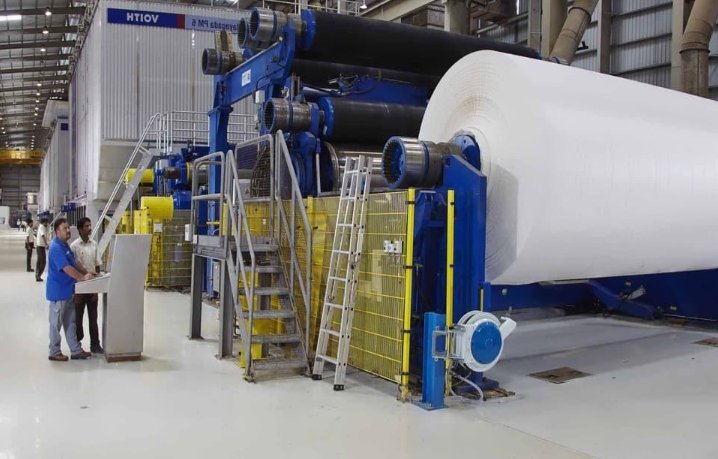
India’s paper industry serves a wide range of sectors, including education, publishing, packaging, healthcare, pharmaceuticals, food processing, e-commerce, retail, banking, and government services. Demand for paper products changes continuously because of economic growth, consumer behaviour, digital commerce, seasonal events, and industrial production. Many paper manufacturers still rely on historical sales trends when planning production, often resulting in excess inventory or supply shortages. An AI-Powered National Paper Demand Forecasting Platform can help manufacturers predict future demand more accurately and improve decision-making across the industry.
The platform would collect information from thousands of sources, including educational institutions, e-commerce companies, retail chains, packaging manufacturers, publishers, logistics providers, export markets, government procurement portals, and industrial production databases. Artificial intelligence would combine these datasets into a unified forecasting engine capable of identifying demand patterns months in advance.
Machine learning algorithms would continuously analyse economic indicators, festival seasons, agricultural production, manufacturing activity, export orders, consumer spending, and industrial growth. Instead of reacting after demand changes, paper manufacturers could prepare production schedules before market demand increases.
Packaging paper represents one of the fastest-growing segments of the industry. AI would monitor online shopping activity, warehouse expansion, food delivery services, pharmaceutical production, and export packaging requirements to estimate future consumption of corrugated boxes, kraft paper, carton board, and speciality packaging materials.
Educational demand would also be forecasted. School admissions, university enrolments, examination schedules, textbook publishing cycles, notebook manufacturing, and government education programmes would all contribute to demand models for writing and printing paper.
Healthcare and pharmaceutical industries require specialised paper products for labels, medical packaging, sterile wrapping materials, and documentation. Artificial intelligence would analyse production forecasts from these industries, allowing paper mills to allocate manufacturing capacity accordingly.
The publishing industry would benefit from improved planning as well. AI could estimate newspaper circulation, magazine printing, commercial publishing activity, advertising demand, and book production trends using real-time market intelligence.
Export forecasting would become another important capability. The platform would monitor international paper consumption, packaging demand, freight rates, import regulations, and global economic conditions. Indian manufacturers would receive recommendations regarding export opportunities in different regions before competitors identify emerging demand.
Raw material procurement would become more efficient. AI would estimate future requirements for wood pulp, bamboo pulp, agro-residues, recycled fibre, chemicals, and packaging inputs. Suppliers could align production with expected industry demand, reducing shortages and price volatility.
Energy planning would also improve. Paper manufacturing consumes significant amounts of electricity, steam, and water. Accurate production forecasts enable manufacturers to optimise energy procurement, reducing operating costs while improving sustainability.
Banks and financial institutions would benefit from better industrial intelligence. Demand forecasts support lending decisions related to capacity expansion, working capital, machinery investments, and export finance. Reliable market projections reduce financial uncertainty.
Insurance companies could use demand analytics to evaluate operational risks associated with production planning, inventory management, and warehousing. Better forecasting contributes to improved risk assessment across the paper value chain.
Government agencies responsible for industry, education, commerce, forestry, and economic planning would receive aggregated national dashboards showing future demand trends across different paper categories. These insights would support investment planning, industrial policy, and resource allocation.
Artificial intelligence would continuously improve its forecasting accuracy by comparing predicted demand with actual market outcomes. Machine learning models would automatically adapt as consumer behaviour, industrial production, and economic conditions evolve.
Cloud computing would provide scalable infrastructure capable of processing billions of records from businesses across India. Manufacturers, suppliers, distributors, exporters, and policymakers would access customised dashboards tailored to their operational needs.
Cybersecurity would protect commercially sensitive information such as production schedules, procurement plans, customer contracts, and market intelligence. Secure cloud infrastructure, encrypted communications, digital identity management, and continuous monitoring would ensure data integrity.
Technology companies could develop forecasting software, AI analytics platforms, industrial dashboards, cloud infrastructure, and business intelligence tools designed specifically for the paper industry. Universities and research institutions could contribute advanced forecasting models, economic analytics, and consumer behaviour research to improve prediction accuracy.
As India’s manufacturing sector continues to expand, data-driven planning will become increasingly important. Companies capable of accurately forecasting demand will reduce waste, improve profitability, strengthen supply chains, and respond more effectively to changing market conditions.
An AI-Powered National Paper Demand Forecasting Platform represents a strategic Industry 4.0 investment for India. By combining artificial intelligence, big data, cloud computing, predictive analytics, and national market intelligence, India can build a smarter paper industry that improves manufacturing efficiency, supports sustainable growth, strengthens exports, and enhances the competitiveness of the entire paper value chain.