India has no shortage of technology professionals. The country produces large numbers of software engineers, data analysts, cloud specialists and artificial intelligence professionals every year.
Yet Industry 4.0 is creating a different kind of skill requirement.
The person who understands the factory floor and the data centre at the same time is still relatively uncommon.
This could become one of India’s most important industrial skill gaps.
A traditional manufacturing engineer understands machines, production processes, maintenance and quality. A software engineer understands applications, databases and networks. A data scientist understands statistical models and machine learning.
Industry 4.0 increasingly requires these worlds to interact.
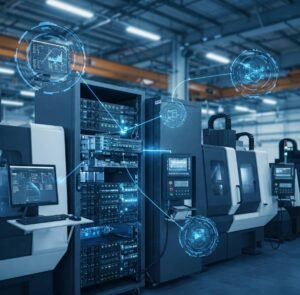
A factory sensor may generate information about vibration. That information needs to travel through an industrial network. It needs to be stored and cleaned. An analytics system may then identify an unusual pattern. Finally, an engineer needs to determine whether the pattern actually represents a mechanical problem.
The entire chain requires multiple skills.
If the organisation has specialists who understand only individual sections, valuable information can be lost between them.
This is why the industrial data engineer could become an important new role in India.
Such a professional would not simply build dashboards. They would understand what the machines are doing and why the information matters.
They might work with PLCs, SCADA systems, industrial communication protocols, sensors, databases, cloud platforms and analytics tools.
More importantly, they would understand manufacturing context.
A machine’s data cannot always be interpreted like ordinary business data.
A sudden change in temperature may indicate a failure, but it may also reflect a change in material or production speed. A reduction in output may indicate mechanical deterioration, but it could also be caused by a shortage of raw materials.
Industrial data has a physical meaning.
Understanding that physical meaning is essential.
This creates a problem for Indian companies trying to implement Industry 4.0.
They may be able to purchase the technology, but finding people capable of integrating it effectively can be much harder.
The traditional educational structure does not always prepare people for this intersection.
Engineering education often separates mechanical, electrical, electronics, computer science and industrial disciplines. Industry 4.0 is doing the opposite.
It is bringing these disciplines together.
A mechanical engineer increasingly needs some understanding of data.
A software engineer working in manufacturing needs some understanding of machinery.
An automation engineer needs to understand cybersecurity and networks.
A data scientist working with factory information needs to understand how production processes actually behave.
This could create demand for new forms of industrial education in India.
Instead of teaching Industry 4.0 as a collection of technologies, educational institutions could teach it as an integrated industrial system.
Students could work with real machines, sensors and controllers while simultaneously learning databases, analytics and machine learning.
This would be particularly valuable for India’s manufacturing clusters.
The industrial skill gap is not necessarily located in Bengaluru or Hyderabad.
It exists inside factories across automotive, textiles, food processing, engineering, pharmaceuticals, electronics and other sectors.
Many of these companies may have excellent domain experts but limited digital capabilities.
A young engineer who can bridge those capabilities could therefore become extremely valuable.
There is another important dimension.
Industrial data engineers could help preserve knowledge.
Factories often depend on experienced technicians who have spent decades working with particular machines. They know the sounds, temperatures, vibrations and behaviours associated with normal and abnormal operation.
Much of this knowledge is informal.
As experienced workers retire or move to other organisations, some of that knowledge disappears.
Digital systems can potentially capture portions of it.
An engineer can combine sensor readings with maintenance records and technician observations to create structured knowledge about machine behaviour.
Over time, the factory develops a digital memory.
This could become a major competitive asset.
The skill requirement also extends to management.
Industry 4.0 professionals need to understand economics, not just technology.
Installing sensors everywhere is not necessarily valuable. A company needs to know which measurements can improve production, reduce downtime, lower energy consumption or improve quality.
The best industrial data engineer may therefore be someone who can ask a deceptively simple question.
What decision will this data improve?
That question can prevent factories from collecting enormous amounts of information without a clear purpose.
India’s Industry 4.0 transition could consequently create a new hierarchy of technical skills.
Basic digital literacy will become increasingly common.
Specialised software skills will remain valuable.
But people who can connect physical industrial systems with digital intelligence may become particularly scarce.
This scarcity could affect India’s manufacturing competitiveness.
A multinational company can purchase advanced machinery from anywhere in the world. It can license sophisticated software. It can deploy cloud infrastructure.
But the ability to integrate all of these technologies into an existing Indian factory depends heavily on people.
Human capability becomes the integration layer.
This is why India’s Industry 4.0 challenge should not be measured only by the number of smart factories being established.
It should also be measured by the number of people capable of making those factories genuinely intelligent.
The country has already built a large technology workforce.
The next step is to connect that workforce with industrial knowledge.
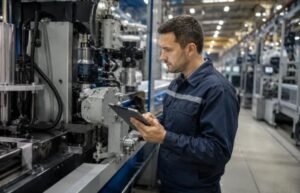
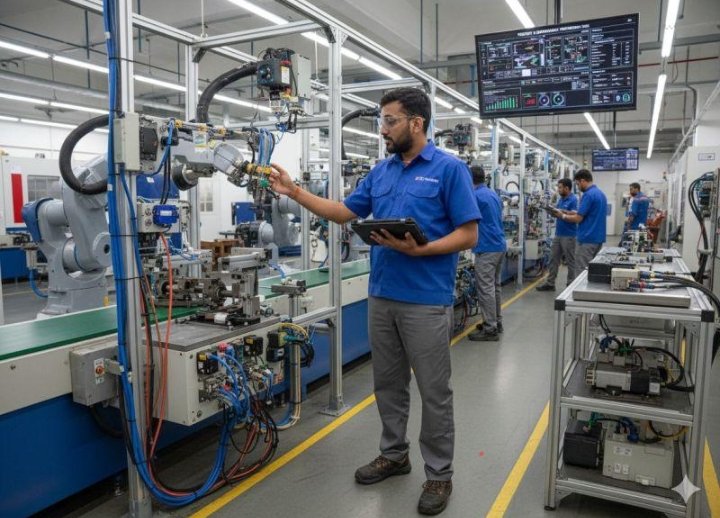
The future may belong to engineers who are equally comfortable standing beside a production machine and analysing its data.
India does not simply need more software engineers for Industry 4.0.
It needs people who can speak both languages.
The language of machines.
And the language of data.