Agricultural governance is usually divided across departments, schemes and institutions. One agency handles cultivation, another irrigation, another markets, another food processing, another rural development, while research institutions operate separately. The farmer, however, experiences all of these systems simultaneously.
A more advanced model would create an integrated agricultural governance platform that connects the entire value chain.
The platform would bring together information about land, crops, genetics, water, weather, production, storage, processing capacity, transportation, markets and industrial demand. The purpose would not simply be to collect data. It would be to create an operating picture of the agricultural economy.
Imagine a district administration knowing several months in advance that a particular region is likely to produce an unusually large banana harvest. Instead of waiting for prices to collapse after harvest, the system could identify available processing factories, cold storage, transport capacity and potential buyers.
Government could then coordinate infrastructure and private investment before the problem appears.
This approach changes agricultural governance from reactive administration into economic coordination.
The same platform could identify regions where farmers are producing crops without sufficient local processing capacity. Instead of treating this simply as a farming problem, policymakers could recognize it as an industrial infrastructure gap.
A district producing large quantities of fruit might require pulping and freezing facilities. A spice-growing region might need drying, grading and extraction infrastructure. A coconut-producing area might require more advanced oil, fibre and biomaterial processing.
Agricultural policy could therefore become closely connected to industrial policy.
The platform could also maintain detailed information about crop varieties and their characteristics. Researchers could study which varieties perform best under particular environmental conditions and which possess characteristics valuable to processors.
Machine learning could help identify relationships between genetic characteristics, field performance and processing outcomes. Government research programmes could then focus resources on areas with clear agricultural and industrial potential.
Farmers would benefit from better information as well.
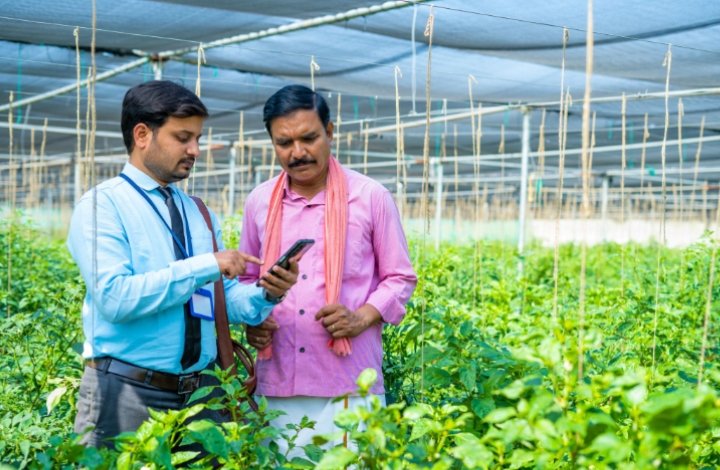
A digital agricultural interface could show available extension services, approved planting material, local processing opportunities, collection centres, storage facilities and potential procurement programmes.
The farmer would not need to understand the entire administrative structure behind these services. The digital system would act as a single entry point.
This could also reduce fragmentation.
Different government departments often collect similar information independently. A common agricultural data architecture could allow authorized agencies to use compatible information while reducing repeated paperwork for farmers and businesses.
Data governance would therefore become essential.
Farmers should know what information is being collected and how it is used. Sensitive commercial information should not automatically become public. Access should be based on clearly defined rules, with appropriate security and accountability.
The objective should be to create useful agricultural intelligence without creating a surveillance-heavy agricultural bureaucracy.
Another important feature would be processing capacity mapping.
Every agricultural region could maintain a live inventory of processing facilities. The system could record the type of equipment available, approximate capacity, operating periods and location.
A farmer cooperative with a large harvest could potentially identify available processing capacity nearby rather than searching manually.
Processors could also identify future raw-material availability and plan factory operations accordingly.
This would create a digital market around agricultural infrastructure itself.
The same principle could apply to cold storage, warehouses, testing laboratories, transportation and packaging facilities.
Instead of building every facility independently, regional governments could encourage shared infrastructure that multiple businesses and farmer organisations can access.
Agricultural governance could thus become a platform for coordinating physical assets.
The system could also connect agricultural policy with climate and resource management.
If policymakers consider expanding a crop, they could examine its projected water requirements, soil impact, energy consumption, processing demand and economic value.
Rather than evaluating a crop only through its market price, governments could examine its entire resource and value chain.
This would enable more sophisticated agricultural planning.
The future agricultural governance system could eventually operate as a regional agricultural control room, not in the sense of centrally controlling farmers, but by providing decision-makers with a continuously updated view of the agricultural economy.
Production forecasts could be displayed alongside storage capacity, processing demand, logistics availability, market prices, water conditions and weather risks.
When conditions change, government agencies and industry participants could respond faster.
The most important transformation would be institutional.
Agriculture should no longer be treated as an isolated rural sector. It is simultaneously a biological system, a manufacturing input, a food system, a logistics network, an employment system and an export industry.
Governance needs to reflect this reality.
The goal should be to create an agricultural ecosystem in which farmers, researchers, processors, logistics companies, financial institutions and government agencies can coordinate without each institution operating inside its own information silo.
Such a system would allow agricultural policy to move beyond subsidies and individual schemes toward long-term economic architecture.
The question would no longer be simply how much a region produces.
The more important question would become how effectively the region converts biological resources into income, employment, food security, industrial products and technological capability.
That is the foundation of a modern agricultural governance system.