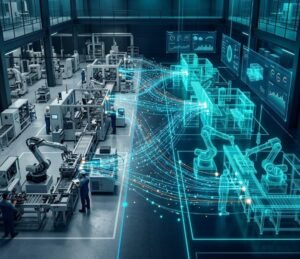
Industry 4.0 has introduced an attractive idea into manufacturing: the digital twin. A physical machine, production line or entire factory can have a digital counterpart that continuously reflects what is happening in the real world. Managers can supposedly monitor operations, simulate changes, predict failures and optimise production without physically interfering with the factory.
The concept is powerful.
But in India, an important question comes before the digital twin.
How accurately does the digital system actually represent the factory?
A digital twin is only as useful as the information entering it. If the physical factory produces incomplete, inconsistent or inaccurate data, the digital representation can become an impressive technological model of an imperfect reality.
This is an unusual Industry 4.0 problem because companies can appear technologically advanced while having a weak foundation underneath.
A manufacturer may purchase sophisticated analytics software and create dashboards showing machine utilisation, energy consumption, production output and maintenance indicators. Management may see graphs updating in real time and assume that the factory has become data driven.
But the underlying measurements may not be sufficiently reliable.
A temperature sensor may have drifted from its original calibration. A vibration sensor may have been installed in an unsuitable location. A production counter may not distinguish between test pieces and finished products. An operator may manually correct machine output at the end of a shift. A network interruption may create gaps in the historical record.
The digital twin then begins to diverge from the physical factory.
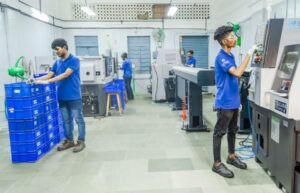
This is particularly relevant to Indian manufacturing because many factories are operating with mixed generations of equipment. Some machines may have advanced digital interfaces while others require retrofitted sensors. Different suppliers may use different communication standards. Maintenance practices may also vary considerably between machines.
The result can be a fragmented data environment.
One machine might provide hundreds of parameters every second. Another might provide only a few measurements. A third might have no direct digital connection at all.
Trying to construct a single digital representation from this information is difficult.
The problem becomes even more complicated when measurements are technically correct but operationally misunderstood.
Consider electricity consumption.
A digital system might notice that a machine consumes significantly more power during one production period. An algorithm could identify this as an anomaly. But perhaps the factory was deliberately producing a heavier component during that period. The increased energy consumption may therefore be completely normal.
Without knowledge of the production context, the data can be misleading.
The same issue exists with machine temperature.
A higher temperature may indicate an impending failure. But it could also be the normal operating condition for a particular product, production speed or environmental situation.
Industry 4.0 therefore requires more than sensors.
It requires context.
Indian manufacturers could increasingly face a situation where they possess millions of individual data points but lack the contextual information required to interpret them.
This creates an important distinction between data collection and industrial intelligence.
Collecting data is relatively easy. Understanding what the data means is considerably harder.
There is also the question of data ownership.
In a modern factory, information can originate from machines, workers, suppliers, maintenance contractors, enterprise software and external systems. When these sources are connected, companies need to decide who owns the information, who can access it and how long it should be retained.
This becomes particularly important when manufacturers work with technology vendors.
A company may install an Industry 4.0 platform supplied by an external provider. Over time, the platform may accumulate years of valuable information about machine performance, maintenance patterns and production behaviour.
If the manufacturer later changes vendors, can the accumulated information easily move to another platform?
If the answer is no, digital transformation can create a new form of technological dependency.
India’s manufacturing sector therefore needs to consider data portability and interoperability alongside automation.
There is another less obvious problem.
A digital twin can create false confidence.
Managers are accustomed to dealing with physical machinery. If a machine produces an unusual sound, an experienced technician may investigate it immediately. If a production line begins behaving differently, an experienced supervisor may recognise the change through observation.
When a dashboard says everything is normal, however, people may become less willing to question the system.
This can create an automation bias.
The digital system becomes trusted because it appears objective.
But the system is not necessarily objective. It reflects the sensors, assumptions, classifications and algorithms used to construct it.
For India, this has implications for the development of predictive maintenance.
Predictive maintenance is often presented as one of the major benefits of Industry 4.0. If machines can continuously report their condition, artificial intelligence can theoretically identify patterns before failures occur.
But predictive maintenance requires historical examples of both healthy and unhealthy machine behaviour.
A factory with inconsistent maintenance records may not have enough high-quality historical information to train reliable models.
An old machine may have experienced hundreds of failures, but the organisation may not have recorded the exact circumstances of those failures. The maintenance team may simply have replaced a component and returned the machine to production.
Years later, an AI system may have enormous sensor data but very little trustworthy information about what actually happened during previous failures.
This is where India’s existing industrial knowledge becomes extremely valuable.
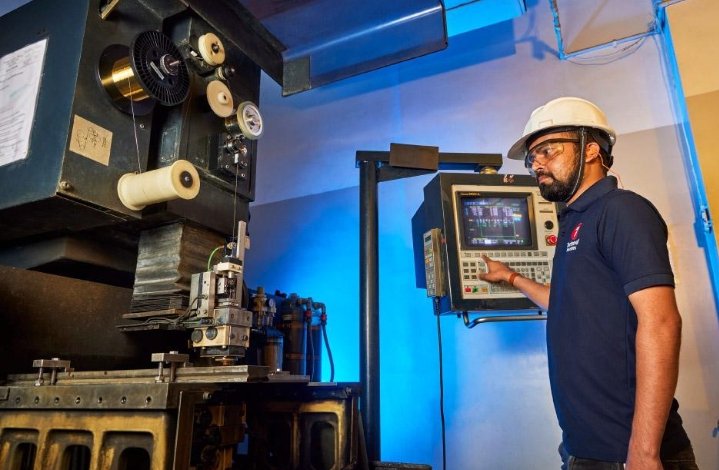
Experienced technicians often possess knowledge that has never been digitally recorded. They know which sounds indicate trouble, which temperature changes matter and which combinations of symptoms precede a breakdown.
Industry 4.0 should therefore not attempt to eliminate this knowledge.
It should capture and structure it.
The transition from traditional manufacturing to intelligent manufacturing could involve converting the experience of technicians, operators and engineers into structured industrial knowledge that can be combined with sensor data.
This could become an important research and business opportunity in India.
Instead of merely asking whether a factory has enough sensors, companies should ask whether they have enough trustworthy information.
That means establishing calibration routines, standardising machine identifiers, recording maintenance events consistently, documenting operating conditions and ensuring that data remains comparable over time.
It also means understanding when not to automate.
Some industrial decisions may continue to require human judgement because the available data is incomplete or because the consequences of an incorrect decision are too significant.
The smartest factory may therefore not be the one where humans disappear.
It may be the one where human knowledge and machine-generated information are combined effectively.
India’s Industry 4.0 transformation will ultimately depend on this foundation.
Digital twins can become extremely powerful tools for production planning, maintenance, energy management and capacity optimisation. But their value will depend on whether the digital representation remains faithful to the physical factory.
The challenge is therefore deceptively simple.
Before building a digital twin of an Indian factory, manufacturers need to understand the physical twin first.
They need to know what their machines are doing, why they are doing it, how accurately it is being measured and which information can actually be trusted.
Only then does the digital factory become more than a collection of attractive dashboards.
It becomes a reliable representation of industrial reality.