
One of the most dangerous weaknesses in administration is also one of the easiest to overlook. An administrator may be energetic, experienced in public life and highly confident, yet still make poor decisions because the decisions are not grounded in reliable data.
This happens when personal impressions become substitutes for evidence. An officer hears a few complaints, speaks to several people, receives reports from subordinates and develops an opinion about what is happening. That opinion then becomes the basis for policy. A project is approved, a programme is expanded, a department is criticised or resources are shifted, even though nobody has established what the actual situation is.
The problem is not that administrators should stop using experience or judgement. Good administration requires both. The problem begins when judgement is used without testing it against reality.
Modern governance is becoming increasingly dependent on data because governments now possess enormous quantities of administrative information. India has been building extensive digital systems across areas such as identity, taxation, health, education, welfare and public infrastructure. The National Data Governance framework approved in 2026 explicitly recognises data as a strategic resource and seeks greater interoperability between government databases.
Yet having data is very different from governing through data.
A department may have thousands of records and still make decisions based largely on anecdotes. The data may sit in another department. It may be collected in incompatible formats. It may be outdated. Nobody may have checked its accuracy. Or senior administrators may simply not know how to interpret it.
This creates a peculiar form of administrative blindness. The government can appear highly informed because there are dashboards, reports, portals and spreadsheets everywhere, while the actual decision-making process remains largely subjective.
Consider a simple example. A district administrator receives repeated complaints that a particular government service is performing badly. The complaints are loud and politically visible. The administrator immediately directs additional staff and funds towards the problem.
But suppose the available records show that the district’s overall performance is actually better than the state average. Perhaps the complaints are concentrated in one particular block. Perhaps the problem concerns a specific category of citizens. Perhaps the real issue is not insufficient staff but a broken software system.
Without analysing the data, the administration may solve the wrong problem.
This is why good governance requires administrators to ask a basic question before taking major decisions: What does the evidence actually show?
The question sounds simple, but it changes the nature of administration.
Instead of asking which village is complaining the loudest, an administrator can examine complaint volumes by location. Instead of assuming that a hospital needs more doctors, the administration can study patient loads, waiting times, absenteeism, bed occupancy and referral patterns. Instead of announcing that a road project is progressing well, officials can compare physical progress, expenditure, contractor performance and completion timelines.
Data does not automatically produce the correct answer. It creates a stronger foundation for asking the right questions.
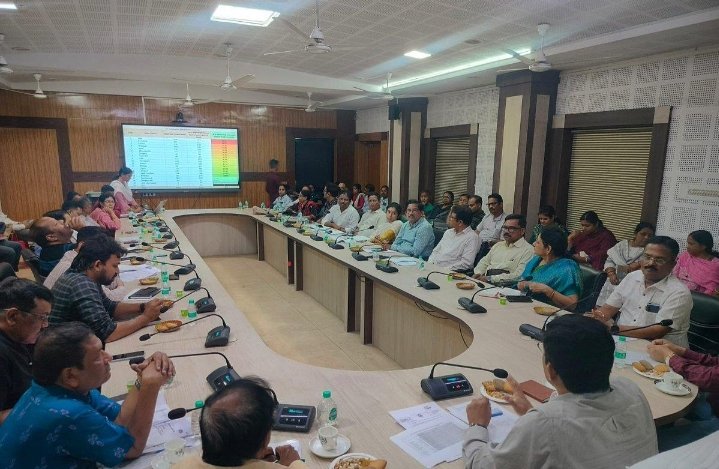
India’s own governance institutions have increasingly emphasised this approach. NITI Aayog has used dashboards and structured review meetings to connect administrative data with monitoring and compliance. Its district and block review systems are designed to use historical trends and performance indicators rather than relying entirely on verbal reporting.
The distinction is important because verbal reporting has a built-in weakness. Information moves through several layers of administration before reaching the person making the decision. At every layer, information can be simplified, selectively presented or unintentionally distorted.
A senior administrator may therefore receive a polished picture of reality rather than reality itself.
A data system can expose some of these distortions. If a department claims that 95 percent of applications have been processed, the administrator can ask how long processing actually took. If a project is marked as completed, photographs, geospatial information, expenditure records and citizen feedback can potentially be examined. If a welfare programme claims high coverage, administrators can compare beneficiary records against population and demographic data.
This is where data becomes more than a reporting mechanism. It becomes a challenge to administrative assumptions.
However, amateur administrators often make another mistake. They believe that any number is useful simply because it is a number.
This produces what might be called decorative data governance. Presentations contain colourful charts, dashboards show dozens of indicators and meetings begin with impressive statistics. Yet nobody asks whether the indicators measure the outcome that actually matters.
For example, an education department may celebrate the number of training programmes conducted for teachers. But the real question may be whether student learning improved. A municipal authority may celebrate the number of kilometres of roads constructed. The more important question may be whether travel time, road safety and connectivity improved.
Counting activities is easy. Measuring outcomes is harder.
Good administrators therefore need to distinguish between input data, activity data, output data and outcome data.
Money spent is not development. Meetings conducted are not reform. Applications processed are not necessarily services delivered. Infrastructure inaugurated is not necessarily infrastructure functioning properly.
The administrator’s job is to connect these layers.
Another major problem is selective use of data. An inexperienced administration may search for statistics that confirm what it already believes. If an administrator believes a programme is successful, favourable numbers are highlighted. Negative indicators are dismissed as exceptions.
This is particularly dangerous because data can be manipulated without anyone technically falsifying it. The choice of indicator, time period, geographic boundary and comparison group can completely change the story.
A serious administrator therefore needs contradictory evidence.
If a policy appears successful, the next question should be: What evidence would prove us wrong?
That question introduces intellectual discipline into governance.
Data also needs context. A sudden increase in complaints may indicate deteriorating services, but it may also indicate that citizens have gained easier access to a complaint system. A fall in reported crime may indicate improved safety, but it could also reflect underreporting.
Numbers need interpretation.
This is why the future of administration is not simply about putting more dashboards in government offices. It is about developing administrators who understand statistics, systems, causality, measurement and uncertainty.
India’s recent emphasis on harmonising administrative data reflects precisely this challenge. Government institutions have been working toward standardised and interoperable datasets so that information from different departments can be used together for planning and service delivery.
The deeper transformation is cultural.
An amateur administrator asks, “What do I think is happening?”
A stronger administrator asks, “What does the evidence suggest is happening?”
A very strong administrator goes one step further: “What evidence would change my mind?”
That final question is crucial.
Governance is too consequential to be driven by personality alone. Administrators control budgets, infrastructure, public services, regulations and institutional priorities. A wrong assumption at the top can therefore become an expensive mistake for thousands or millions of people.
The answer is not to eliminate human judgement. It is to make judgement accountable to evidence.
The best administrators are not those who know everything. They are those who know what they do not know, know where to find the evidence and build systems that allow reality to challenge their assumptions.
In the age of digital government, data should not merely decorate the presentation made to the administrator.
It should be capable of changing the administrator’s mind.