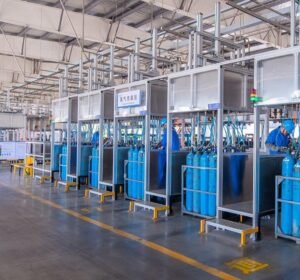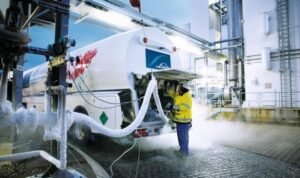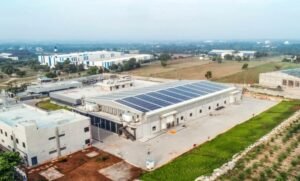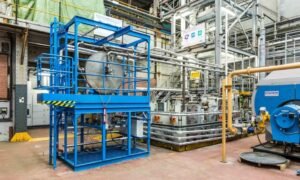
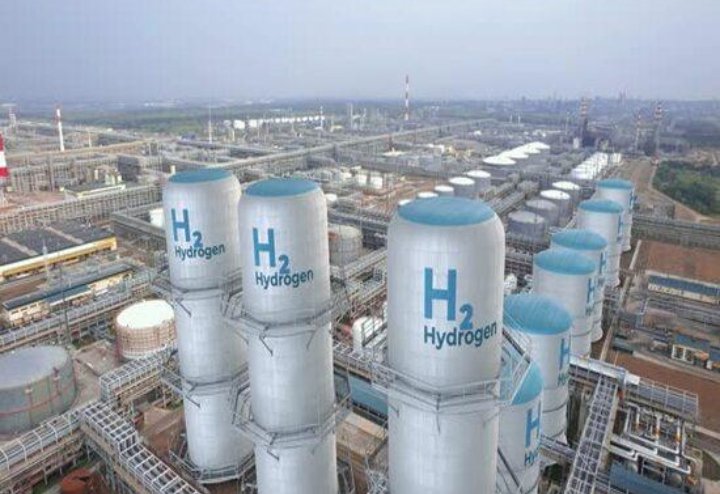
Green hydrogen is expected to become one of the defining industries of the coming decades, supporting clean energy, steelmaking, fertilizers, transportation and industrial decarbonization. While hydrogen production receives significant attention, hydrogen storage equipment is equally critical for building a complete hydrogen economy. High-pressure cylinders, cryogenic tanks, composite storage vessels, transport containers and industrial storage systems will be essential for safely storing and transporting hydrogen. Industry 4.0 offers India an opportunity to become a global manufacturing hub for hydrogen storage equipment through intelligent production systems.
Hydrogen storage equipment requires precision engineering because hydrogen is stored under extremely high pressures or at cryogenic temperatures. Manufacturing involves steel processing, composite fabrication, precision welding, heat treatment, machining, non-destructive testing and pressure certification. Every manufacturing stage must achieve exceptional quality to ensure safety and long service life.
Industry 4.0 enables continuous monitoring of production through connected sensors installed across fabrication workshops, robotic welding cells, composite winding machines, machining centres, heat treatment furnaces and testing laboratories. Engineers receive real-time information that improves process stability and manufacturing precision.
Artificial intelligence enhances manufacturing by analysing production histories together with live operational information. Machine learning models identify optimal welding parameters, curing conditions and machining settings that improve structural integrity while reducing material waste and production costs.
Digital twins create virtual replicas of hydrogen storage vessels and manufacturing facilities. Engineers can simulate pressure cycles, temperature variations, structural loads and fatigue behaviour before physical production begins. Virtual testing shortens development time while reducing engineering risks.
Predictive maintenance improves reliability across robotic welders, CNC machines, filament winding systems, compressors and hydraulic testing equipment. Connected sensors monitor vibration, temperature, motor performance and equipment wear, allowing maintenance teams to prevent unexpected production interruptions.
Automated quality inspection plays a vital role because hydrogen storage vessels must meet stringent international safety standards. Machine vision systems, ultrasonic testing, X-ray inspection and laser measurement technologies continuously verify weld integrity, wall thickness and dimensional accuracy. Artificial intelligence helps identify defects before products move to final certification.
India’s National Green Hydrogen Mission is expected to generate strong domestic demand for hydrogen storage infrastructure. Smart manufacturing enables equipment suppliers to produce standardized, high-quality storage systems for hydrogen production plants, transport companies and industrial users.
Composite pressure vessels represent a particularly promising area. Carbon fibre reinforced storage cylinders provide lighter weight and higher strength compared to conventional steel tanks. Industry 4.0 supports precise fibre placement, resin curing and structural inspection required for advanced composite manufacturing.
Supply chain integration connects steel suppliers, composite material manufacturers, fabrication facilities, testing laboratories and customers through digital manufacturing platforms. Better coordination improves production planning, reduces inventory costs and strengthens supply chain resilience.
Energy optimization improves manufacturing efficiency across welding operations, heat treatment furnaces, machining centres and testing facilities. Intelligent monitoring systems identify opportunities for energy savings while maintaining product quality.
Environmental sustainability also benefits from Industry 4.0. Digital monitoring reduces material waste, improves recycling of metal scrap and composite materials, and optimizes resource utilization throughout manufacturing operations.
Worker safety is strengthened through connected monitoring of robotic work cells, pressure testing stations, heavy lifting equipment and gas handling systems. Automated warning systems allow operators to respond immediately whenever abnormal operating conditions arise.
Research and development accelerates through data-driven engineering. Artificial intelligence analyses manufacturing performance, material testing results and operational data to identify opportunities for lighter storage vessels, improved fatigue resistance and lower manufacturing costs.
Indian engineering companies can develop specialized automation software, digital inspection systems and manufacturing execution platforms specifically designed for hydrogen equipment production. These technologies can strengthen India’s industrial software ecosystem while supporting the growth of the hydrogen economy.
Engineering institutions should introduce specialized programs covering hydrogen technologies, pressure vessel engineering, composite materials, robotics and industrial automation. Future engineers will require interdisciplinary expertise that combines mechanical engineering, materials science and digital manufacturing.
Government initiatives supporting green hydrogen, advanced manufacturing and industrial digitalization can accelerate Industry 4.0 adoption across hydrogen equipment manufacturing. Collaboration among research institutions, manufacturers and technology firms can strengthen domestic technological capabilities while reducing dependence on imported equipment.
Global investment in hydrogen infrastructure is expected to increase substantially over the coming decades. Countries capable of manufacturing reliable, certified and cost-effective hydrogen storage equipment will become important participants in international clean energy supply chains.
Industry 4.0 transforms hydrogen storage equipment manufacturing into an intelligent production ecosystem where precision, safety and efficiency are continuously optimized. By integrating artificial intelligence, predictive maintenance, digital twins, robotics and automated quality inspection, India’s hydrogen storage equipment industry can support the country’s clean energy ambitions while building a globally competitive advanced manufacturing sector.