India has set an ambitious goal of becoming a global defence manufacturing hub. Over the past decade, the country has expanded domestic production of military equipment, encouraged private sector participation, and promoted indigenous innovation under the Atmanirbhar Bharat initiative. While these efforts have strengthened the defence industrial base, the next stage of growth will depend on adopting Industry 4.0 technologies across the entire manufacturing ecosystem.
Modern defence production is far more complex than conventional manufacturing. Military aircraft, naval vessels, armoured vehicles, missiles, communication systems, radars, and electronic warfare equipment require exceptional precision, strict quality standards, and highly secure production environments. Industry 4.0 provides the digital foundation needed to meet these demanding requirements while improving productivity and reducing costs.
Industry 4.0 combines artificial intelligence, industrial Internet of Things, robotics, digital twins, additive manufacturing, cloud computing, machine vision, and advanced analytics to create intelligent factories. These technologies allow manufacturers to automate repetitive tasks, optimise production processes, improve quality, and make faster operational decisions based on real time data.
Precision manufacturing is particularly important in defence production. Even the smallest defect in a missile guidance component, aircraft engine part, or radar system can affect operational performance. Machine vision systems equipped with artificial intelligence can inspect components with remarkable accuracy, identifying defects that may not be visible during manual inspections. Continuous digital quality monitoring improves reliability while reducing production waste.
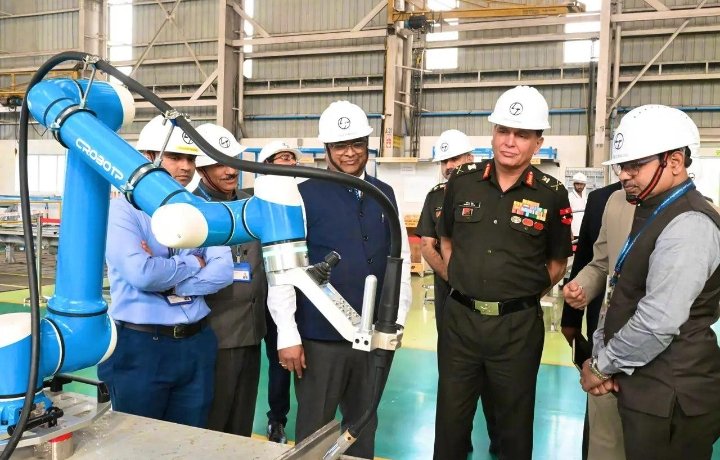
Robotics is becoming an essential part of modern defence manufacturing. Automated systems perform welding, machining, painting, assembly, and material handling with high precision and consistency. Robots also improve workplace safety by handling hazardous processes involving chemicals, heavy equipment, or extreme temperatures. Human workers can then focus on engineering, quality assurance, and system integration tasks that require specialised expertise.
Digital twins are transforming how defence equipment is designed and manufactured. Engineers create virtual models of aircraft, ships, vehicles, engines, and production facilities before physical manufacturing begins. These digital models allow designers to simulate performance, optimise manufacturing processes, identify engineering problems, and reduce development costs. The result is faster product development with fewer design revisions.
Additive manufacturing, commonly known as three dimensional printing, is creating new possibilities for defence production. Complex components that previously required multiple manufacturing stages can now be produced with fewer processes while reducing material waste. Rapid prototyping also allows engineers to test new designs quickly before moving into large scale production.
Artificial intelligence enhances production planning by analysing manufacturing data, supplier performance, equipment utilisation, and customer demand. AI systems recommend efficient production schedules, identify supply chain risks, and improve resource allocation. As defence manufacturing projects often involve thousands of components from multiple suppliers, intelligent planning becomes increasingly valuable.
Supply chain resilience has become a strategic priority for every major defence manufacturer. Industry 4.0 technologies improve visibility across suppliers, production facilities, logistics providers, and inventory systems. Manufacturers can monitor component availability in real time while responding more quickly to disruptions affecting critical defence programmes.
Cybersecurity occupies a central position within defence manufacturing. Production systems contain highly sensitive information related to national security, advanced technologies, engineering designs, and intellectual property. Connected factories must therefore operate with the highest cybersecurity standards, including encrypted communications, secure industrial networks, zero trust architecture, and continuous threat monitoring.
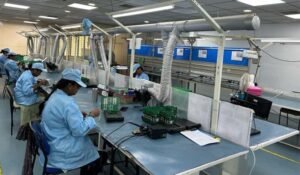
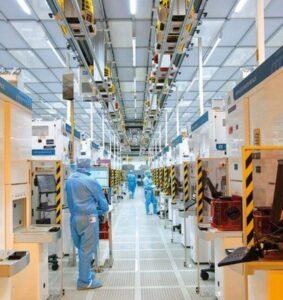
India’s expanding defence electronics sector can particularly benefit from Industry 4.0. Manufacturing advanced communication systems, sensors, navigation equipment, and electronic warfare technologies requires highly automated production environments with exceptional precision. Smart factories improve manufacturing quality while supporting rapid technological innovation.
The aerospace sector also stands to gain significantly. Aircraft manufacturing depends on precision engineering, strict regulatory compliance, and extensive quality documentation. Digital production systems automatically record manufacturing parameters throughout the production process, simplifying certification while improving product traceability.
Small and medium enterprises are essential contributors to India’s defence supply chain. Many specialised companies manufacture precision components, electronic assemblies, mechanical systems, and industrial equipment. Affordable Industry 4.0 technologies, shared digital platforms, and government supported innovation centres can help these businesses modernise while remaining competitive within global defence supply chains.
Research institutions, universities, and defence laboratories should work closely with industry to develop indigenous Industry 4.0 technologies. India already possesses strong capabilities in software engineering, artificial intelligence, electronics, and advanced manufacturing. Combining these strengths with defence research can accelerate innovation while reducing dependence on imported industrial technologies.
Workforce development remains equally important. Engineers, technicians, production managers, and quality specialists must develop expertise in robotics, industrial automation, artificial intelligence, cybersecurity, data analytics, and digital manufacturing. Educational institutions should integrate these disciplines into engineering programmes to prepare future defence manufacturing professionals.
Government policy has a crucial role in supporting this transformation. Investments in advanced manufacturing research, industrial digital infrastructure, semiconductor development, precision engineering, and defence innovation can strengthen India’s long term competitiveness. Collaboration between public sector enterprises, private industry, startups, and academia will further accelerate technology adoption.
Global defence markets increasingly value manufacturing capability alongside product performance. International customers expect reliable quality, transparent production processes, digital traceability, and efficient delivery schedules. Industry 4.0 enables Indian manufacturers to meet these expectations while improving export competitiveness.
India’s ambition to become a leading defence manufacturing nation requires more than expanded factory capacity. It demands intelligent factories capable of producing sophisticated defence equipment with exceptional precision, security, and efficiency. By embracing Industry 4.0, India can strengthen national security, increase indigenous production, expand defence exports, and establish itself as a trusted global supplier of advanced military technologies.