
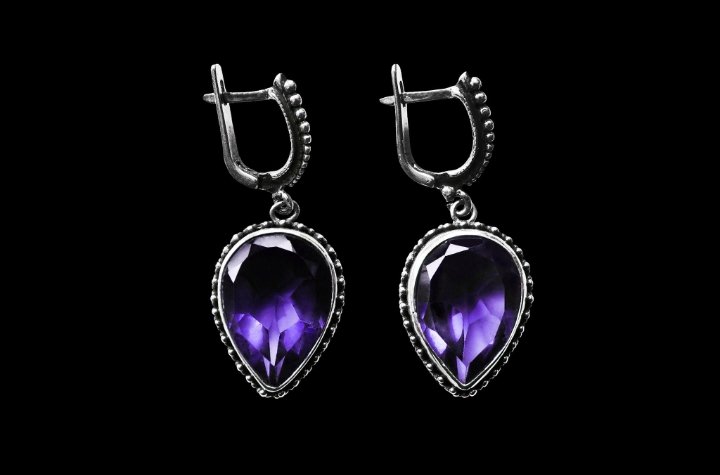
Amethyst is one of the world’s most popular semi precious gemstones, admired for its rich purple colour, durability, and versatility in jewellery. It is widely used in earrings, pendants, rings, bracelets, and necklaces sold across Europe, North America, the Middle East, and Asia. India is a major centre for gemstone cutting and jewellery manufacturing, with thousands of skilled artisans producing handcrafted amethyst jewellery for domestic and export markets. As international buyers demand greater consistency, faster delivery, and certified quality, Industry 4.0 technologies can help modernize production through a Smart Manufacturing Platform designed specifically for amethyst earrings.
The manufacturing of amethyst earrings involves numerous precision stages. Gemstones are sourced, cut into matching pairs, polished, graded, mounted into metal settings, inspected, polished again, cleaned, packaged, and prepared for shipment. Since earrings are sold as identical pairs, even a slight variation in colour, size, brilliance, or weight can reduce their commercial value. Traditional inspection methods depend heavily on manual observation, making large scale production both time consuming and susceptible to inconsistency.
A Smart Manufacturing Platform connects every production stage using artificial intelligence, Internet of Things technology, robotics, cloud computing, and digital manufacturing software. Instead of treating each workstation independently, the entire factory operates as one connected ecosystem where machines, workers, and production systems exchange information continuously.
Artificial intelligence begins by matching gemstones into suitable pairs. High resolution imaging systems analyse thousands of amethyst stones based on colour intensity, transparency, dimensions, weight, crystal structure, and surface finish. Machine learning identifies the closest possible matches, ensuring that every pair of earrings maintains visual consistency expected by international buyers.
Computer vision systems then inspect gemstone cutting accuracy. Cameras positioned above production stations measure symmetry, facet alignment, polish quality, and dimensional precision within fractions of a millimetre. Artificial intelligence immediately identifies stones requiring additional polishing or recutting before they reach the assembly stage.
Robotic gemstone setting systems assist skilled jewellers during manufacturing. Precision robotic arms position gemstones into silver, gold, platinum, or stainless steel settings with exceptional accuracy. Craftsmen remain responsible for artistic finishing while repetitive positioning tasks become automated, reducing production time and minimizing handling damage.
Internet of Things sensors continuously monitor production equipment. Laser cutters, polishing machines, ultrasonic cleaners, casting equipment, and engraving systems transmit operational information to a centralized manufacturing dashboard. Artificial intelligence analyses equipment performance and predicts maintenance requirements before unexpected breakdowns interrupt production.
Digital twins create virtual replicas of every earring design before manufacturing begins. Designers evaluate gemstone placement, weight distribution, structural integrity, and manufacturing feasibility using simulation software. Potential production issues are identified digitally, reducing the need for costly physical prototypes.
Cloud computing enables real time coordination across multiple factories and supplier networks. Production managers monitor order progress, inventory levels, machine performance, worker productivity, and export schedules from secure digital dashboards. International buyers can receive live production updates for large purchase orders.
Blockchain technology creates permanent digital manufacturing records. Every amethyst earring receives a unique digital identity documenting gemstone origin, quality grading, manufacturing stages, inspection results, and export certification. Retailers and consumers can verify authenticity by scanning a secure digital code accompanying each product.
Artificial intelligence also supports production scheduling. The system analyses customer orders, machine availability, workforce capacity, gemstone inventory, and shipping deadlines to optimise factory operations. Manufacturing resources are allocated automatically, reducing delays while improving overall productivity.
Quality inspection remains one of the platform’s strongest features. Multiple computer vision stations inspect finished earrings for scratches, loose gemstone settings, polishing defects, incorrect dimensions, colour mismatches, and surface imperfections. Every product receives an objective digital quality score before packaging.
Manufacturers benefit through lower material waste, improved production efficiency, shorter lead times, and greater consistency across large export orders. Skilled artisans spend less time performing repetitive inspection tasks and more time focusing on craftsmanship, innovation, and product development.
Banks financing jewellery manufacturers gain access to verified digital production records that improve inventory valuation and collateral assessment. Insurance companies benefit from accurate manufacturing documentation and continuous monitoring of production facilities, reducing operational risk.
Government agencies responsible for exports, handicrafts, and manufacturing can analyse anonymised production data to identify technology adoption trends, export growth, quality improvements, and productivity gains across India’s jewellery clusters.
Technology companies have opportunities to develop AI inspection systems, robotic assembly equipment, industrial vision cameras, cloud manufacturing software, blockchain certification platforms, and digital twin solutions specifically designed for gemstone jewellery production. Research institutions can contribute advanced imaging technologies, robotic manipulation techniques, and machine learning algorithms that further improve gemstone manufacturing.
Global consumers increasingly expect jewellery that combines traditional craftsmanship with modern quality assurance. Manufacturers capable of delivering certified, traceable, and consistently produced products will strengthen their competitive position in international markets.
A Smart Manufacturing Platform for amethyst earrings represents a significant Industry 4.0 opportunity for India’s semi precious jewellery sector. By integrating artificial intelligence, robotics, computer vision, digital twins, Internet of Things technology, blockchain, and cloud computing into a unified manufacturing environment, India can improve quality, increase production efficiency, strengthen export competitiveness, and reinforce its reputation as one of the world’s leading producers of high quality gemstone jewellery.