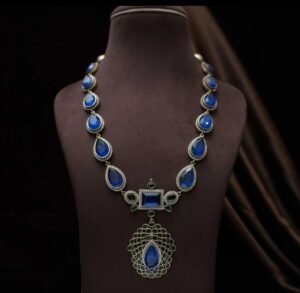
India’s semi-precious jewellery industry is renowned for combining traditional craftsmanship with contemporary design. Cities such as Jaipur, Mumbai, Surat, Hyderabad, and Delhi produce jewellery featuring gemstones like amethyst, garnet, citrine, moonstone, turquoise, lapis lazuli, agate, onyx, quartz, peridot, and topaz for customers across the world. However, product development often requires multiple physical prototypes, lengthy design revisions, and expensive material testing. A Smart Jewellery Digital Twin Platform can modernize the industry by creating virtual replicas of jewellery before manufacturing begins.
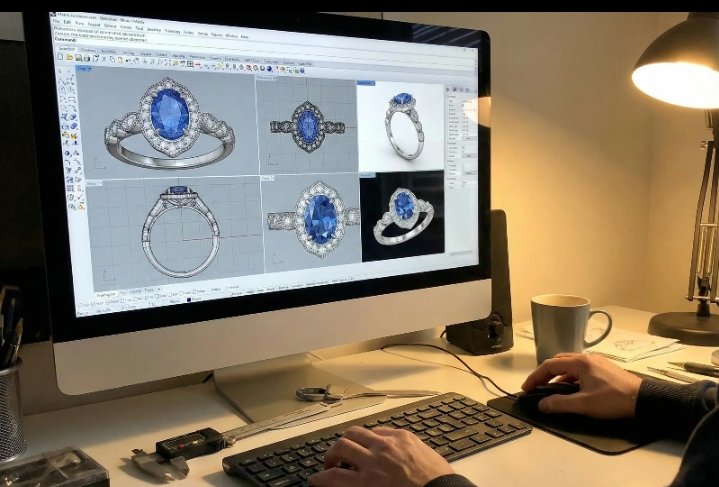
A digital twin is a virtual model that accurately represents a physical jewellery product. Designers create necklaces, rings, earrings, bracelets, pendants, bangles, brooches, and gemstone settings inside a digital environment where every measurement, gemstone placement, metal weight, and structural detail is precisely simulated.
Artificial intelligence becomes the core of the platform. AI evaluates thousands of previous jewellery designs to recommend gemstone arrangements, metal combinations, setting techniques, and manufacturing methods based on durability, appearance, customer preferences, and production efficiency.
Before a single gemstone is mounted, the digital twin simulates the complete manufacturing process. Engineers can identify weak settings, excessive metal usage, poor weight distribution, or potential manufacturing defects without producing physical samples. This reduces material wastage while shortening product development cycles.
Computer-aided design software integrates directly with the digital twin platform. Designers modify gemstone sizes, colours, cuts, and metal finishes in real time while immediately viewing realistic three-dimensional renderings. Customers can approve designs digitally before production starts.
Manufacturing facilities equipped with CNC machines, laser cutters, automated polishing equipment, and precision casting systems receive digital instructions directly from the virtual model. This minimizes manual interpretation and improves production consistency across multiple manufacturing locations.
Computer vision systems inspect finished jewellery and compare it against the original digital twin. Artificial intelligence measures gemstone alignment, prong positioning, polish quality, dimensional accuracy, and finishing standards. Any deviations are automatically identified before products leave the factory.
Custom jewellery becomes easier to produce. Customers can personalise gemstone combinations, engraving, ring sizes, pendant shapes, or bracelet lengths using an online interface. The digital twin updates instantly, generating revised manufacturing specifications without requiring complete redesigns.
Exporters benefit by presenting highly detailed virtual models to international buyers before production. Wholesale customers can review multiple design variations digitally, reducing sample shipping costs and accelerating order approvals.
Augmented reality integration allows retailers to display virtual jewellery collections without maintaining large physical inventories. Customers can visualise customised jewellery using smartphones or smart mirrors before placing orders.
Blockchain technology records every design revision, manufacturing stage, quality inspection, and ownership transfer. This creates a permanent digital history that strengthens intellectual property protection while improving traceability.
Banks financing jewellery inventories benefit because digital twins provide accurate information regarding metal content, gemstone value, manufacturing costs, and inventory status. Insurance providers also gain improved visibility into product specifications for valuation and claims processing.
Government agencies supporting handicrafts, exports, and manufacturing can analyse anonymised production data to identify emerging design trends, export demand, and technology adoption across the jewellery industry.
Cloud computing enables designers, manufacturers, gemstone suppliers, and retailers to collaborate regardless of location. Digital models, production data, and customer approvals remain synchronised across secure cloud infrastructure.
Cybersecurity protects valuable jewellery designs, manufacturing specifications, customer information, and intellectual property using encrypted communications, secure cloud architecture, digital identities, and continuous monitoring.
Technology companies can develop AI design software, digital twin platforms, computer vision systems, cloud collaboration tools, manufacturing automation software, and augmented reality applications specifically for the jewellery industry. Universities and research institutions can contribute advanced materials science, gemstone simulation models, and AI-driven design optimisation techniques.
As international buyers increasingly demand personalised, high-quality, and rapidly delivered jewellery, digital manufacturing will become an important competitive advantage.
A Smart Jewellery Digital Twin Platform represents a transformative Industry 4.0 opportunity for India’s semi-precious jewellery industry. By integrating artificial intelligence, digital twins, computer vision, cloud computing, blockchain, and advanced manufacturing, India can reduce production costs, accelerate product development, improve quality, strengthen exports, and reinforce its position as one of the world’s leading jewellery manufacturing hubs.